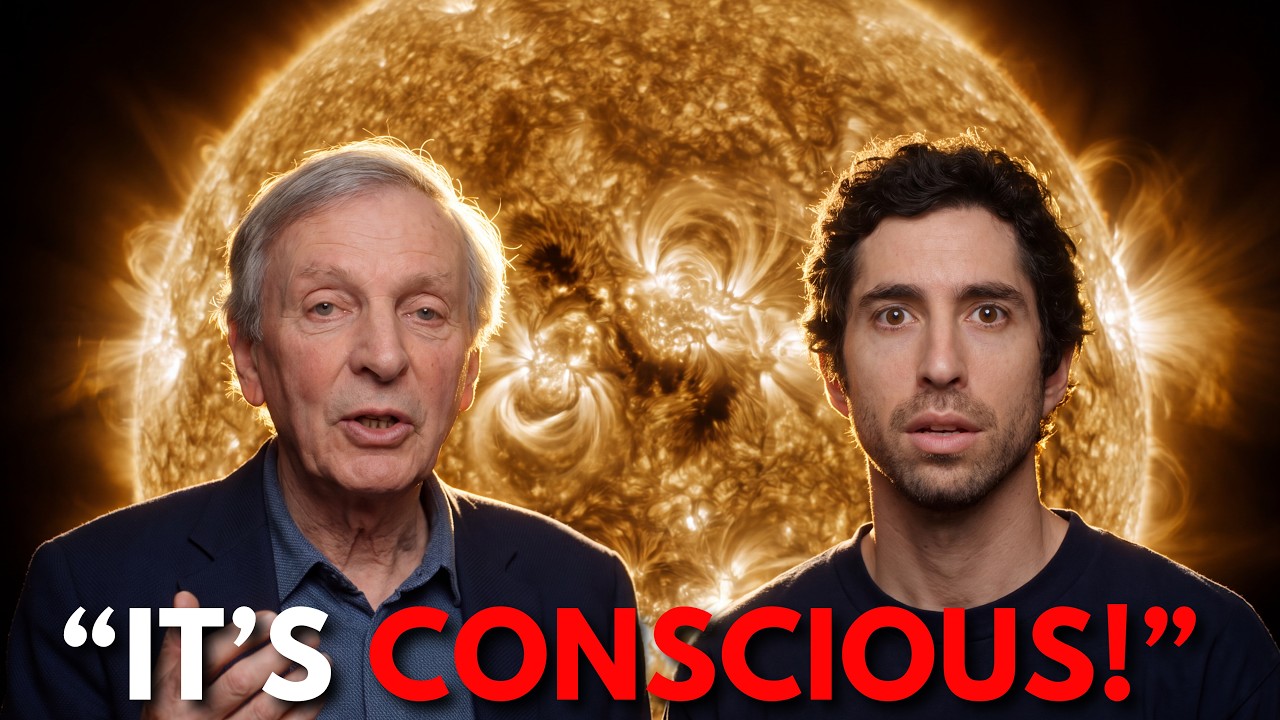
This episode features biologist and author Rupert Sheldrake discussing his research on morphic fields, morphic resonance, extended mind, telepathy, the nature of vision, consciousness in the sun and plasma, and spiritual practices — arguing that mainstream science has excluded essential formative and conscious principles that could explain persistent anomalies in biology, physics, and human experience.
Morphic fields and morphic resonance
Sheldrake proposes that self-organizing systems at all levels — crystals, plants, animals, societies — are shaped by morphic fields, a new kind of field in physics that carries an inherent memory through morphic resonance.
Morphic resonance is the influence of similar patterns on other similar patterns across space and time; a developing oak tree “tunes in” to past oak trees, a baby spider spins a web by resonating with ancestral spiders, and learned behaviors can spread across a species without genetic or epigenetic transmission.
Key evidence: Rats trained to escape a water maze at Harvard showed progressive improvement over generations (250 trials → ~25 trials). When replicated in Edinburgh and Melbourne, control-line rats whose ancestors were never trained improved just as much, suggesting a species-wide memory effect not explained by genetics or epigenetics.
Similar effects appear in crystal formation (new crystals form faster once the same structure has been made elsewhere), crossword puzzle solving, and skill acquisition like skateboarding tricks or the four-minute mile.
Sheldrake rejects a “central server” model; instead, resonance operates directly across space and time based on similarity, a distributed process more like the internet than a single database.
Extended mind, telepathy, and the limits of AI
Sheldrake argues minds extend beyond brains through fields, enabling telepathy, the sense of being stared at, and other “psi” phenomena — capacities AI lacks because it is modeled on left-brain computation, not embodied, field-based, or spiritual dimensions of mind.
Telephone telepathy: ~85% of people report thinking of someone who then calls; controlled experiments with randomized callers show statistically significant hit rates.
Dogs knowing when owners return: Filmed experiments rule out routine, vehicle sounds, smells, and cues from people at home; dogs wait at the door significantly more often when owners are on the way, even at random times in unfamiliar vehicles.
Mother-baby telepathy: Nursing mothers often experience milk let-down and breast tingling when their distant baby is distressed, not at feeding times; filmed coincidences support this.
Sense of being stared at: ~95% of people report this; experiments show people turn precisely toward the gaze source, even through clothing and fur, suggesting a field-based detection system, not skin sensation.
Why animals seem better: Not biological loss but cultural suppression — Western education dismisses these abilities; shamanic cultures cultivate them. Most humans still have the experiences but label them “coincidence.”
Commercial/military use limited: Telepathy requires strong emotional bonds; you cannot spy on strangers. Remote viewing programs (CIA, 23 years) exist but are not reliably instrumentalizable for profit or strategy.
Vision: extra-mission vs. intro-mission
The standard model: light enters eyes → retinal images → brain processing → internal “virtual reality” display (a “controlled hallucination” inside the skull). No one has ever seen images inside a brain; this is an assumption.
Sheldrake favors the extra-mission (extramission) view — held by most children, ancient Greeks, and traditional cultures — that vision projects images outward to where they appear. The image of a tree is at the tree, not inside the head.
Mechanistic candidate: Cramer’s transactional interpretation of quantum mechanics — photon absorption involves a “handshake across space and time” with a reverse-time confirmation wave. If mind couples to this, it could explain the outward influence in vision and the sense of being stared at.
Detection mechanism unknown: Not skin (works through clothing/fur). Sheldrake speculates the bioelectric field (heart’s EM field detectable feet away) may be the interface between morphic fields and the body.
Fields in physics: from Faraday to morphic fields
Faraday’s lines of force introduced fields as physical but non-material — structures in space with causal effects at a distance, not made of matter. Einstein removed the “ether”; fields became fundamental (“fields all the way down”).
Morphic fields are analogous to quantum matter fields (which shape electron orbitals) — they are formative, not energetic. They bias inherent randomness (quantum or chaotic) without expending energy, like a magnet biasing steel balls on a Galton board.
Formative causation (Aristotle’s formal cause) was excluded by the 17th-century mechanistic revolution (only material + efficient causes). Biology’s morphogenesis problem persists because science lacks formal causes.
Relationship to EM fields: Morphic fields may use bioelectric fields as an interface, but EM fields alone cannot carry species-wide form and memory. Sheldrake compares this to the electron’s dual fields (quantum matter + electric) — coexisting, interacting, not fully explained.
Consciousness, the sun, and plasma
The sun may be conscious: Organized plasma structures (stars, ball lightning, Kordylewski clouds at Lagrange points) could sustain consciousness. Not random plasma, but self-organized, electromagnetically complex plasma.
Fred Hoyle’s The Black Cloud (1950s sci-fi) imagined an intelligent plasma cloud communicating via EM signals — this freed Sheldrake early from “consciousness requires brains.”
Robert Temple’s The New Science of Heaven: Universe is mostly plasma; plasma filaments connect galaxies like nerve fibers. Electric Universe theorists argue gravity is secondary to EM forces; dark matter is an ad hoc fix for gravity-only models.
Ball lightning and plasmoids: Anomalous, accepted by physics but unexplained; videos show plasmoids cohering to human heartbeat. Moses’ burning bush may have been a sentient plasmoid.
Ancient sites: Stone circles may concentrate telluric currents to attract ball lightning, linking sacred experiences to plasma phenomena.
Angels and the imaginal realm
Physics of Angels (with Matthew Fox): Aquinas described angels as acting with whole being (quantized), moving between places with no elapsed time from their perspective — like photons.
Angels as beings of the imaginal realm: Not mere fantasies; the imaginal world drives culture (Hollywood, novels, dreams). Los Angeles was named for Our Lady of the Angels by Franciscans.
Good/bad angels map to higher impulses vs. seven deadly sins (now amplified by advertising). Psychedelic churches (Santo Daime) invoke angels collectively.
Reality of the imaginal: If imagination shapes history, its ontology matters — is it only neural activity, or a conscious realm we tap into? All traditional cultures assume the latter.
Time, precognition, and presentiment
Waking before alarms: ~95% report this. Not an evolved “biological clock” (ancestors had no 4:30 AM flights). Sheldrake proposes presentiment — emotional arousal from a future event reaches backward.
Precognitive dreams: Collected dreams before 9/11 showed striking correspondences. Animals predict earthquakes days ahead (Chinese used this in 1970s); Western seismologists dismiss it as folklore.
Proposed earthquake warning app: Crowdsourced animal behavior reports (dogs frightened, snakes waking, birds agitated) mapped in real time; surges would flag regions for research. Blocked by institutional ridicule, not cost or feasibility.
Day trading and presentiment: Top traders “just know” which screen to watch seconds before moves. Sheldrake suggested training with simulated trading + immediate feedback to hone presentiment — a potential commercial application that could legitimize the phenomenon.
Synchronicities
Three types: (1) Telepathic (think of someone → they call), (2) Precognitive (think of someone → unexpectedly meet them; Sheldrake calls this pro-apanthesia), (3) Meaningful coincidences beyond telepathy/precognition — suggesting higher patterning (Jung’s focus), currently unresearchable.
AI and the future of science
AI scrapes existing knowledge; it does not generate new ideas or design crucial experiments. It floods inboxes with AI-generated “theories of everything” (hyperdimensions, prime matrices) — theoretically easy, empirically empty.
Real progress requires empirical anomalies, not theory-spinning. Kuhnian paradigm shifts come from phenomena that don’t fit — telepathy, morphic resonance, presentiment, solar consciousness.
Institutional barriers: Parapsychology has ~20–30 active researchers globally; PhD students warned off; funding nonexistent in West. China may lead due to fewer taboos and state support.
Spiritual practices: gratitude as a simple, evidence-based start
Meta-evidence: People with spiritual/religious practices are happier, healthier, longer-lived (thousands of studies).
Gratitude: Simplest, most studied. Writing 5 gratitudes weekly → measurable happiness increase vs. hassles or neutral events. Saying grace before meals — pausing to acknowledge life, food, safety, community — shifts atmosphere positively.
Effect on divine connection: Practices don’t “turn on God like a tap” (grace is a gift), but they remove barriers and make experiencing God’s presence more likely — generally a joyful outcome.