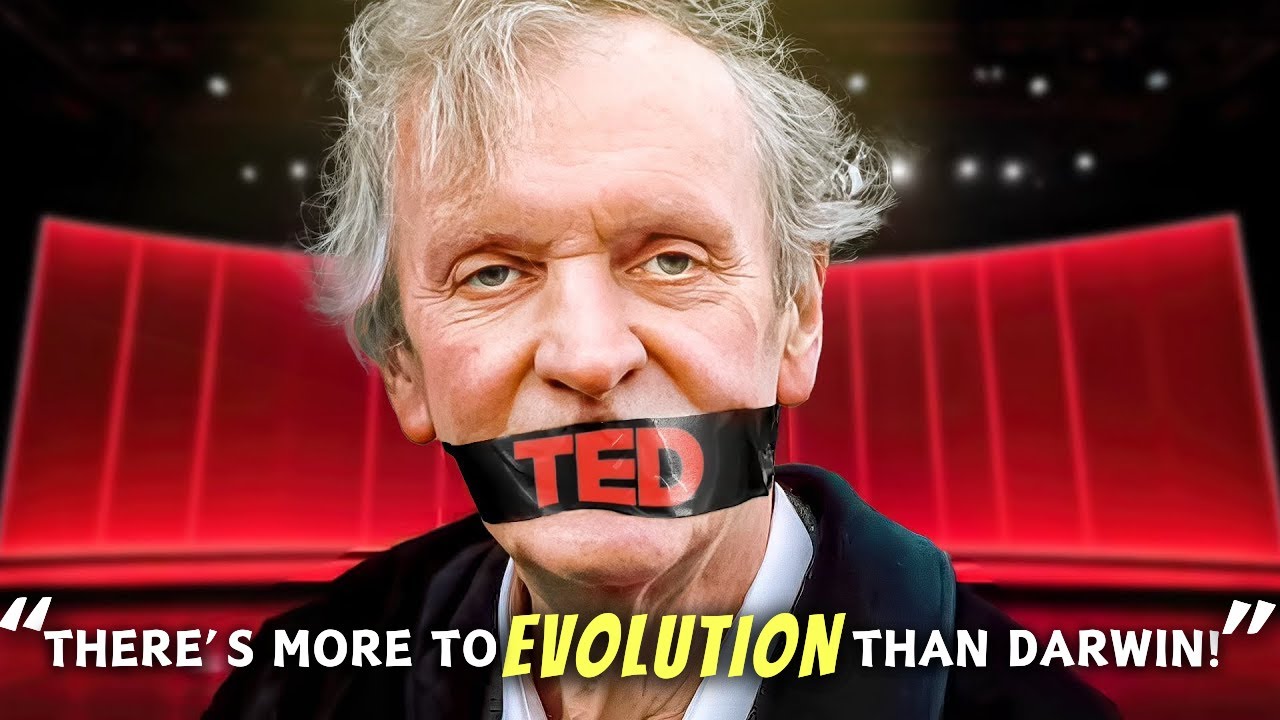
Rupert Sheldrake is a Cambridge-educated, Harvard-affiliated biologist and parapsychologist whose decades of research into phenomena like the sense of being stared at, telepathy, morphic resonance, and the consciousness of nature have made him one of the most controversial figures in modern science. He is both admired for his boldness and marginalized by mainstream academia for challenging mechanistic materialism. This conversation covers his theories on consciousness and vision, his experiments on scopaesthesia, morphic fields and inheritance, pan-psychism and the possibility that the sun is conscious, the physics of angels and its relevance to UFO phenomena, his friendship with Terence McKenna, and his views on AI and the future of science.
Consciousness, Vision, and the Sense of Being Stared At
Sheldrake rejects both materialism (everything is matter) and idealism (everything is consciousness), instead proposing that consciousness interfaces with the physical world through electromagnetic fields.
He challenges the standard neuroscience claim that visual images are constructed inside the brain, arguing instead that what we see is projected outward by the mind to where objects actually are — a model consistent with how physics textbooks explain virtual images in mirrors.
The sense of being stared at (scopaesthesia) is central to his work: most people report experiencing it, and it appears to be directional — subjects turn and look directly at the person staring at them, even from behind or at a distance.
He connects this to a retrocausal model of vision, drawing on the transactional interpretation of quantum mechanics (John Cramer, Ruth Kastner): when light is absorbed by the eye, an “anti-photon” is sent backward in time, creating a standing wave linking observer and observed.
This implies that looking at something involves a two-way connection through the electromagnetic field, and that consciousness may operate from the future toward the past — a view aligned with Alfred North Whitehead’s philosophy of mental causation.
Sheldrake has developed a smartphone app (the “staring app”) that allows anyone to test and train their sensitivity to being stared at, turning it into a citizen science project.
Precognition, Dreams, and the Nature of Time
Precognitive dreams are far more common than most people realize, especially when people start recording their dreams systematically.
After 9/11, Sheldrake collected over 75 dreams from people who had dreamed of planes hitting skyscrapers, people trapped in burning buildings, or streets filled with dust — in some cases days before the event.
He suggests people may have been dreaming their future experience of seeing the images on TV — a “pre-memory” rather than a direct precognition of the event itself.
Historical examples like Morgan Robertson’s 1898 novel Futility, which described a ship called the Titan sinking after hitting an iceberg — eerily presaging the Titanic disaster — illustrate how precognitive knowledge may be more widespread than acknowledged.
He argues that consciousness is fundamentally concerned with possibility and intention, and that intentions (future goals) act back on the present to shape behavior — a form of retrocausation.
Academic Orthodoxy and the Stigma Around Parapsychology
Sheldrake identifies mechanistic materialism as the dominant paradigm in institutional science, which assumes the universe is made entirely of unconscious matter and that consciousness is confined to brains.
Under this paradigm, psychic phenomena are declared impossible by definition, not because they have been tested and failed, but because they contradict the worldview.
Organizations like the Committee for Skeptical Inquiry function as defenders of this orthodoxy, using Bayesian reasoning with priors set so low that no evidence could meaningfully shift them.
Thomas Kuhn’s theory of paradigms explains how anomalies are ignored or explained away until a paradigm shift occurs.
Funding for parapsychology is negligible compared to mainstream science: the largest funder (the BIAL Foundation in Portugal) provides roughly $1 million annually, versus tens of billions for particle physics or biomedical research.
Many elite universities once had parapsychology programs (Princeton, Stanford/SRI), and nearly all researchers involved concluded there was something real — yet these programs were defunded and closed.
Sheldrake notes that many privately sympathetic scientists are “in the closet” about their interests, fearing career damage if they speak openly.
Pan-Psychism and the Consciousness of the Sun
The “hard problem” of consciousness — how subjective experience arises from unconscious matter — has led to the revival of pan-psychism in academic philosophy: the idea that some form of consciousness exists throughout nature, from electrons to brains.
Sheldrake extends this to ask: if pan-psychism is taken seriously, could the sun be conscious?
He proposes the electromagnetic field as the interface between consciousness and physical bodies — just as brain waves (electromagnetic activity) correlate with conscious states, the sun’s vastly more complex electromagnetic field, which extends throughout the solar system, could serve as the interface for a solar mind.
The sun could exercise choice in the direction of solar flares and coronal mass ejections, with enormous consequences for life on Earth (e.g., the 1859 Carrington Event).
Extending further: if the sun is conscious, why not other stars, the galaxy (whose structure resembles a neural network connected by plasma filaments and magnetic fields), and ultimately the entire universe?
Morphic Fields and Morphic Resonance
Sheldrake’s central theoretical contribution is the hypothesis of morphic fields and morphic resonance:
Morphic fields are fields of form and organization that shape all self-organizing systems — atoms, molecules, cells, tissues, organisms, societies — at every level the whole is more than the sum of its parts.
Morphic resonance is the process by which these fields are inherited across time: similar systems resonate with previous systems of the same kind, giving nature a kind of collective memory.
DNA codes for proteins but cannot account for the form of a termite colony, the shape of a bird’s wing, or inherited instincts — morphic fields fill this explanatory gap.
Key evidence:
Rats trained to learn a new trick in London should enable rats everywhere to learn it faster through morphic resonance — and experiments with rats at Riverbank and elsewhere support this.
New chemical compounds are notoriously difficult to crystallize the first time, but become easier with repetition — a well-known phenomenon among chemists that morphic resonance would predict.
Athletic records may reflect not just better training and nutrition but a kind of cumulative morphic memory making previously impossible feats more accessible.
Sheldrake argues morphic resonance is a fundamental principle of nature, like gravity — not fully understood mechanistically but measurable in its effects.
He acknowledges that mathematical models of morphic fields exist (e.g., René Thom’s catastrophe theory and topological models with attractors) but notes that most of biology and psychology cannot be reduced to equations either.
Inheritance, Epigenetics, and Morphic Resonance
Darwin himself accepted the inheritance of acquired characteristics (Lamarckian inheritance), citing cases like dogs inheriting a fear of butchers across generations — a view rejected by Neo-Darwinians like Richard Dawkins.
Modern epigenetics (methylation, histone modification, small RNA) has revived the idea that experiences can be inherited, but Sheldrake argues the molecular mechanisms proposed are unproven as the actual cause in most cases.
The mouse fear experiments (Dias & Bhatt, published in Nature): male mice conditioned to fear a smell (acetophenone) produced offspring and grandchildren who feared the same smell, despite no cultural exposure — consistent with either epigenetic inheritance or morphic resonance.
Heart transplant recipients sometimes acquire memories, preferences, or skills of their donors — Sheldrake interprets this as the transplanted heart continuing to resonate with the donor through morphic resonance, not as “cellular memory” stored in the heart’s cells.
Michael Levin’s flatworm experiments: trained flatworms that had their heads removed and regenerated still retained the learned behavior — consistent with morphic resonance with the worm’s previous intact form.
Angels, UFOs, and Intelligence Beyond the Human
Sheldrake co-authored The Physics of Angels with theologian Matthew Fox, exploring medieval Christian, Jewish, and Islamic conceptions of angels as intelligences governing stars, planets, and natural processes.
Medieval thinkers like Pseudo-Dionysius the Areopagite and Thomas Aquinas took for granted that the universe was alive and that each celestial body had a guiding intelligence (angel) — a view rooted in Neoplatonism.
Sheldrake sees these traditional hierarchies of angels as prescient models for thinking about consciousness beyond the human level — the sun, stars, galaxies, and cosmic web as successively higher orders of mind.
He notes that specific attributes described in medieval angel hierarchies (radiated light, electromagnetic-like phenomena, lingering effects) bear striking similarities to modern UFO and alien encounter reports.
He has not personally researched UFOs because they are difficult to study experimentally and are clouded by conspiracy theories, but he acknowledges the parallels.
He suggests that if beings on other planets exist, telepathy would be a more efficient means of contact than physical spacecraft — and that many astronauts return from space with profoundly altered consciousness, turning inward rather than outward.
Electromagnetism, Light, and the Ether
Sheldrake is investigating the fundamental nature of electromagnetism and light, which he believes are closely related to consciousness.
He draws on Michael Faraday, who believed fields of force were primary and matter was merely concentrated field — a view at odds with the modern textbook treatment of field lines as “imaginary” conveniences.
Maxwell’s equations for light work equally well in both directions (past-to-future and future-to-past), which underpins the transactional interpretation of quantum mechanics and Sheldrake’s retrocausal model of consciousness.
He questions whether the ether should be resuscitated: Einstein’s special relativity refuted a specific uniform ether model (Michelson-Morley), but quantum vacuum fluctuations, the Higgs field, and vacuum polarization all suggest space is not truly empty.
He sees electromagnetism as the bridge between morphic fields (mind) and physical processes, with the future-to-past component of electromagnetic interaction being the aspect most closely related to consciousness.
Terrence McKenna, Fungi, and Merlin Sheldrake
Sheldrake was close friends with Terence McKenna, who stayed at his home whenever he was in London; McKenna’s ideas about fungi, consciousness, and language influenced both Rupert and his son Merlin.
Merlin Sheldrake’s book Entangled Life explores fungal intelligence, the ways fungi take over insect minds (e.g., bullet ants directed by Ophiocordyceps), and how the human microbiome influences thought and behavior.
Rupert’s own scientific background is in plant physiology and botany — he spent years in India developing improved crop varieties at an agricultural research institute.
He discusses Francis Crick’s 1973 paper on directed panspermia and the idea that an advanced civilization might send spores of knowledge across the cosmos — but suggests telepathy could achieve the same transfer of information without physical spores.
Edgar Mitchell, the astronaut who walked on the moon, founded the Institute of Noetic Sciences, reflecting how space exploration often leads to consciousness research.
AI and the Limits of Machine Intelligence
Sheldrake is skeptical that current AI approaches will yield real consciousness or genuine understanding.
He uses AlphaFold (DeepMind’s protein structure prediction system) as an example: it works by pattern-matching against thousands of known protein structures, not by understanding the physics of protein folding from first principles — it cannot solve the “multiple minimum problem” that has stymied traditional computational approaches.
All current large language models rely fundamentally on human-supervised learning datasets; only rare cases like AlphaGo Zero use reinforcement learning in rule-bound environments.
The Turing Test, in his view, is a poor measure of consciousness — it tests behavioral mimicry, not subjective experience.
He believes the next great scientific breakthrough will come from understanding the extended mind, the relationship between consciousness and electromagnetic fields, and how memory and nature work through morphic resonance — areas where he sees the current paradigm as most inadequate.