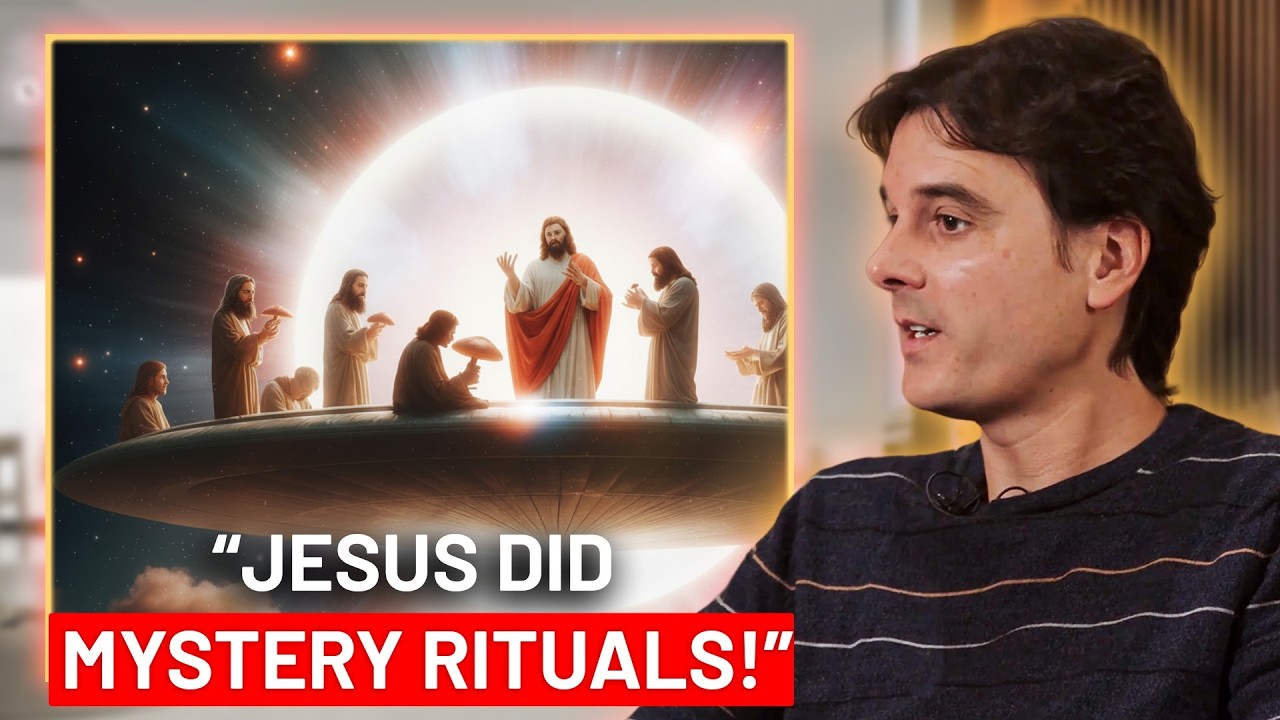
This episode of American Alchemist features Brian Muraresku, author of the New York Times bestseller The Immortality Key, recorded inside the Hagia Sophia in Washington, D.C. The conversation explores Muraresku’s thesis that psychedelic mystery rituals from the ancient Greek world — especially the Eleusinian Mysteries — shaped the foundations of Western civilization and early Christianity, and that this suppressed history has implications for how we understand consciousness, religion, and the future of psychedelic medicine.
The Eleusinian Mysteries and Their Significance
Eleusis, located 13 miles northwest of Athens, was the spiritual epicenter of the ancient Mediterranean — a secret, hermetically sealed ritual that the greatest minds of the classical world, including Plato, Aristotle, Sophocles, Pindar, Pythagoras, and Cicero, undertook as a pilgrimage. Disclosing what happened there was punishable by death, making it, as Muraresku puts it, “the fight club of the ancient world.”
The rites centered on elaborate ceremonies of death and rebirth. Initiates went in as ordinary human beings and emerged believing they were immortal. The experience was described not as learning but as unlearning — a peeling back of layers, a dissolving of the ego, a confrontation with mortality in order to achieve immortality.
The pre-Socratic philosopher Peter Kingsley’s phrase captures the logic: “If you die before you die, you will not die when you die.” This involved practices of incubation — going into underground temples to meet a goddess, entering altered states of consciousness where participants were barely distinguishable from the dead, treading between waking and dreaming.
In 364 AD, when Emperor Valentinian tried to outlaw nocturnal rites and shut down the mysteries, the Roman hierophant Praetextatus warned that killing the mysteries would put the human species in peril — that life itself would become “unlivable” (abiotos in Greek). Muraresku argues this was not a trivial warning but a claim about the functional role these rituals played in sustaining civilization.
The Psychedelic Hypothesis
The central question Muraresku investigates: Was Dionysus the god of wine, or the god of psychedelics? This question was first raised by Professor Carl Ruck of Boston University in The Road to Eleusis (1978), which proposed that the kykeon — the ritual drink consumed at Eleusis — contained ergot, a fungus on wheat that contains LSD-like compounds.
Muraresku’s contribution is to pursue hard scientific and organic chemical data to support what the ancient literary sources only hint at — what was actually in those ancient chalices. The book documents evidence that wine in the ancient world could have been spiked with mushrooms, visionary plants, hallucinogenic herbs, or toxins.
Reverend Martin Luther King Jr. wrote about the influence of mystery religions on Christianity as far back as 1950, noting that the similarities between pagan and Christian ceremonies could not be ignored.
Christianity’s Connection to the Mysteries
Muraresku argues that early Greek-speaking Christian communities between roughly 33 and 300 AD may have availed themselves of the same “technology” documented in the ancient mystery sources. He is careful to say this is a hypothetical possibility, not a certainty.
When Jesus is asked why he speaks in parables, he uses the Greek word mysterion — defined in the Greek lexicon as “a religious secret to be confided only to the initiated and not to be communicated by them to ordinary mortals.” Muraresku’s point: Christianity, by Jesus’s own definition, was born with secrets — not necessarily drugs, but secrets and visions.
The Gospel of John, chapter 6, is what Muraresku calls “the key to the Christian mysteries.” Jesus says, “Whoever eats my flesh and drinks my blood has eternal life” — not will have an afterlife, but has immortality, in the present tense. Verses later: “That person remains in me and I in them” — the goal of communion is to become not just Christ-like but one with Christ, a motif traceable directly back to the mystery initiations of Dionysus.
Muraresku speculates that the Last Supper itself may have been a mystery ritual, and that the kykeon — the psychedelic drink of Eleusis — is what Jesus actually drank.
Consciousness, the Brain, and the Hard Problem
Muraresku describes a childhood near-death experience at age five, when he was hit in the head with a golf club. He felt bliss and no pain while bleeding, and as anesthesia kicked in during surgery, he experienced what he describes as leaving his body and having a vivid dreamlike encounter. Only years later, reading near-death literature and mystical experience research, did he recognize it as a genuine altered state.
He draws on Aldous Huxley’s idea that psychedelics function as a technology — a biochemical tool that, under controlled conditions, can produce vivid near-death-like experiences. Huxley was influenced by William James’s transmission theory of consciousness: the idea that the brain does not generate consciousness but rather transmits or modulates it, like a radio receiver.
Psilocybin appears to silence activity in the default mode network — the anterior and posterior cingulate cortex — which is associated with the ego, fears about the future, and worries about the past. Muraresku suggests that quieting this region may increase the brain’s ability to “tether to elsewhere,” raising the hard problem of consciousness: does the brain generate everything we experience, or does it transceive? Does consciousness exist independently of the physical body?
The Future of Psychedelic Rituals
Muraresku predicts that over the next decade, psychedelic use will develop along three parallel tracks: (1) state-sanctioned therapeutic use, such as the regulated psilocybin ecosystem emerging in Oregon and potential FDA approval for treating anxiety, depression, end-of-life distress, and PTSD; (2) the underground Dionysian culture that has persisted from Woodstock through Burning Man and the Grateful Dead; and (3) First Amendment religious protections for the sacred, responsible use of psychedelics within religious exercise, following models like the Native American Church and Brazilian ayahuasca churches.
He suggests that LSD, DMT, and other compounds may begin to find their way into new churches or even organized religion, potentially creating what Huxley and Albert Hofmann envisioned as a new Eleusis — a religion organized around psychedelic experience.
The Larger Weirdness: Angels, Aliens, and the Muses
Muraresku and host Jesse discuss the broader cultural moment in which UFOs, aliens, and psychedelic experiences are converging in public consciousness. Muraresku notes that what people once called angels, demons, jinns, fairies, and muses are now called aliens — the mythological vocabulary has shifted but the underlying phenomenon may be continuous.
He cites religious studies professor Diana Pasulka’s book American Cosmic, based on Vatican archives, which proposes that 1947 was a dividing line: before Roswell, people saw angels and demons; after, they see aliens. Muraresku also references 19th-century “airship” sightings — visitation events involving humanoid beings who would land on farms and converse with people — as precursors to modern alien contact narratives.
These visitations, like the Eleusinian Mysteries, sometimes leave people traumatized but in other cases transformed for the better — an experience Muraresku compares to a gnostic hierophany or revelation. He acknowledges he has no explanation but treats these as “border areas for research” into the nature of consciousness and reality.
Why It Matters Now
Muraresku frames the book’s purpose as addressing a contemporary identity crisis. The standard narrative — that the Greeks drafted the blueprints of Western civilization and Christianity came to save our souls — leaves an unbridgeable divide between reason and faith, science and religion. His argument is that the mystery traditions were the hidden bridge between these worlds, and that shutting them down risks making life “unlivable.”
He suggests that modern communion in churches like the Hagia Sophia is itself a continuation of the mystery tradition — the creation of sacred space for the irrational to enter our lives through prayer, ritual, and service. The implication is that these practices, stripped of their original psychedelic technology, may be echoes of something far more potent that has been lost or suppressed.