-
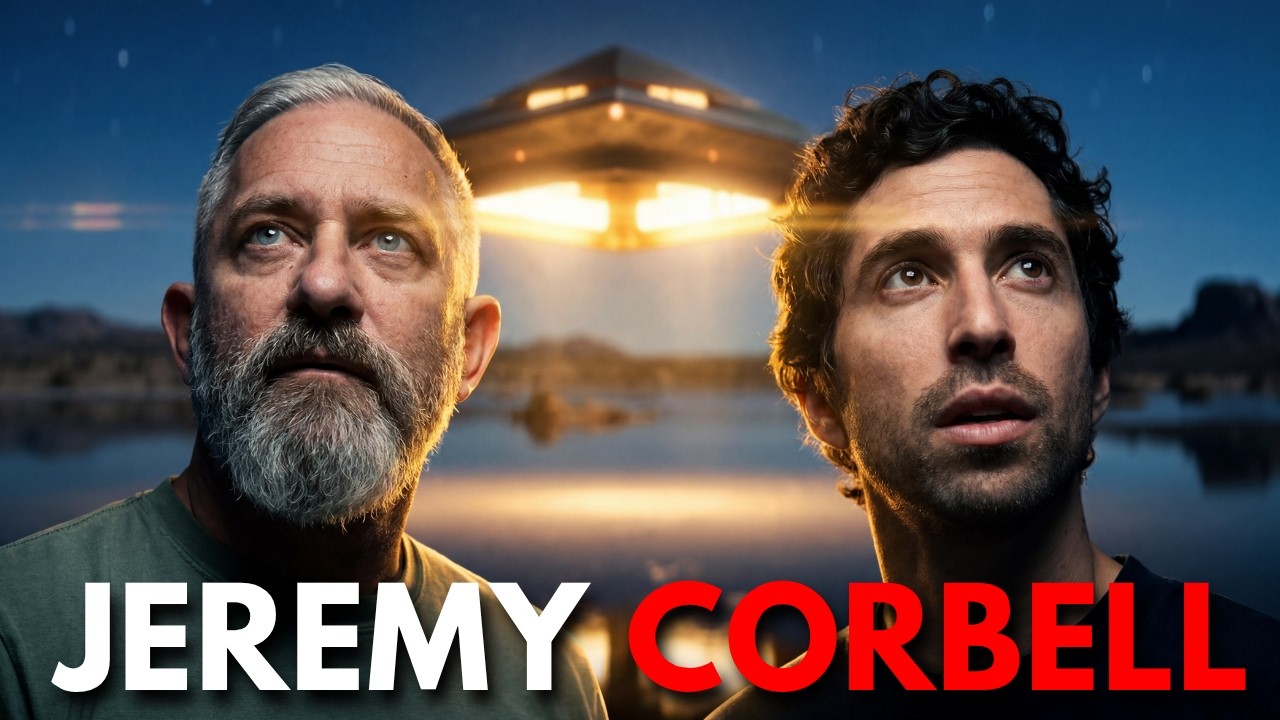
Jeremy Corbell is a filmmaker and investigative journalist who has spent years breaking major UFO stories, including the Bob Lazar case, the David Grusch whistleblower testimony, and the experiences of Dylan Borland and Matthew Brown. He co-hosts the podcast Weaponized with George Knapp and has facilitated over 10 closed-door congressional testimonies from witnesses with direct knowledge of non-human craft and reverse engineering programs.
- Corbell’s approach is defined by extreme vetting, protecting sources, and a refusal to rush stories to publication. He emphasizes that he wants to be right, not first.
- He describes the UFO disclosure landscape as a “Rubik’s Cube” — a constellation of isolated programs, hardware, and personnel that don’t all connect to each other, with protective programs designed to misdirect and dilute genuine investigations.
-
David Grusch’s emergence as a whistleblower was carefully managed by Corbell and Knapp over an extended vetting period.
- Grusch first approached George Knapp at a bar in Huntsville, Alabama, whispering that he was an intelligence officer with information about UAP programs. Corbell filmed the encounter.
- Corbell took Grusch to a bar that night, bought him beers, and began the long process of building trust. He asked Grusch about his lowest personal vulnerabilities — Grusch disclosed PTSD from combat in Afghanistan, which an intelligence agency had tried to weaponize to pull his security clearance.
- Grusch had conducted roughly 40 depositions of people who worked directly on non-human craft. He filed a formal complaint with the Intelligence Community Inspector General (ICIG), the watchdog over all U.S. intelligence agencies, stating that the U.S. government has been reverse engineering non-human craft for decades, has made limited progress, and that “biologics” (non-human pilots/entities) were recovered.
- Corbell notes that Grusch was well-regarded by colleagues across multiple agencies, including those who didn’t work on UAP programs. People who disliked him appeared to have ulterior motives.
-
The “Legacy Program” is not a single program but a fragmented constellation of isolated efforts.
- Corbell explains that different groups hold different pieces — some have hardware, some have power sources, some have biological materials. The Department of Justice has been trying to locate where legacy materials are stored, and different agencies are hiding them from each other.
- Working on a craft is different from working with a craft. Some programs attempt to retrofit non-human power sources into human-built bodies, which Corbell compares to putting a Ferrari engine in a Pinto — the technology is so advanced that human-built platforms can’t handle it.
- There are active protection programs designed to misdirect researchers with seductive but false leads. Corbell warns that even well-meaning insiders can propagate disinformation they were fed by these programs.
-
Jim Lacatski, a senior DIA rocket scientist, confirmed he entered a non-human craft inside a government facility.
- Lacatski was able to get this fact cleared for publication in his book, which Corbell attributes to sympathetic elements within government mechanisms who want partial disclosure.
- Corbell believes there is a war inside the government between those who want secrecy for strategic advantage and those who believe humanity deserves to know the truth. He points to the former VP of Lockheed Martin, Steve Ryder (who gave a strange speech about “the garment of the gods” and consciousness), and Dr. Colin Kellar as examples of insiders who tried to move non-human hardware into the sunlight.
- Lacatski also warned that the U.S. is falling behind in teaching the scientific frameworks needed to understand UAP, and that the brightest minds are not being recruited into this work because of secrecy.
-
Dylan Borland witnessed a large triangular craft on a military base and has provided testimony to the ICIG.
- Borland saw a silent, equilateral triangle craft, one to two stories thick, with four lights (one at each corner, a larger one in the center) and a black metallic flake surface covered in gold, lava-like plasma that moved intelligently before shooting straight up.
- Corbell revealed that the ODNI (Office of the Director of National Intelligence) told him — in what he believes was an entrapment attempt — that Borland had testified about “Project Rubik’s Cube,” a classified UAP program, and had drawn a pyramid-shaped power source and a “hieroglyphic” symbol found on it. Corbell publicly asked Borland to confirm this on stage; Borland neither confirmed nor denied, saying he would only answer if granted formal whistleblower protection.
- Corbell believes the ODNI was trying to entrap both him and Borland, fabricating details to see what Borland had shared privately. He reported this to his lawyer and to Congress.
-
AARO (All-domain Anomaly Resolution Office) under Sean Kirkpatrick functioned as a counterintelligence honey trap against the American public.
- Corbell states that AARO was used to siphon information from whistleblowers and then clamp down on them. Veterans who testified about nuclear-site UAP incidents were not recorded, and AARO personnel took only high-level notes, sometimes locating and destroying evidence.
- He has recorded, documented evidence of AARO intimidating and harassing whistleblowers, which he says would be provable in court.
- AARO’s inception is tied to legacy programs: Kirkpatrick was at SIC (a known legacy program node), and Ronald Moultrie (Under Secretary of Defense) had Battelle on his resume — the same organization behind the original Pentagon memo that created Project Blue Book as a public-facing cover while real investigation happened elsewhere.
- The CIA’s Director’s Initiative Group (DIG), which operated under Tulsi Gabbard at ODNI, was itself running a rogue operation. A CIA agent named John Anglin III recently testified to Congress that the CIA was spying on the very whistleblowers who were brought in through the DIG, monitoring their computers and phones. Corbell facilitated many of those introductions.
-
Matthew Brown discovered the Immaculate Constellation documents through an intelligence server spillage.
- Brown was a State Department employee with TS/SCI clearance doing routine file cleanup when he found a misappropriated upload on a shared Intel link server — a working report on UAP programs that included a photo of Luis Elizondo.
- He reported it through proper channels but received no reassurances, making him fear he would be scapegoated. He proactively documented everything and eventually brought the information to Corbell, who connected it to people in positions of power.
- Brown is described as meticulous, patriotic, and courageous. He endured significant personal hardship after coming forward. He has not yet been allowed to testify publicly in front of Congress, though Corbell and others have fought for it.
- Brown developed a gnostic-influenced worldview from the documents — suggesting that humans might be a “resource” for non-human intelligence. Corbell notes that other people who saw the same documents did not arrive at the same conclusions, suggesting this is Brown’s personal interpretation rather than something stated in the material.
-
Matthew Sullivan, who had direct hands-on work with non-human craft, died suspiciously two weeks before he was scheduled to testify behind closed doors.
- Corbell had been facilitating Sullivan’s testimony. The FBI is investigating whether his death was suspicious. Corbell draws a parallel to the attempts to stop Bob Lazar from speaking out.
- Corbell has personally facilitated over 10 closed-door testimonies in Washington, D.C., a process that can take 2.5 months of vetting with national security personnel.
-
Corbell’s first UFO sighting in Santa Monica was debunked by him, teaching him the importance of rigorous analysis.
- In 2004-2005, Corbell filmed a strange zigzag object in the sky and posted it to YouTube. Bill Nye publicly claimed he had superimposed brine shrimp (sea monkeys) onto the footage. Corbell was outraged and launched a deep investigation, eventually obtaining six angles of the object and matching it to a Red Bull skydiving team’s helmet cam footage showing iridium flares.
- This experience taught him that debunking is essential, that authority figures can be wrong, and that the UFO community often doesn’t want to hear solved cases.
-
The Baghdad Phantom case demonstrated that the disclosure process is working, albeit slowly.
- Corbell and Knapp had reported on the Baghdad Phantom years before the government released the official video. When the first tranche of government UAP releases came out, the actual Baghdad Phantom video was included, along with the pilot’s mission report — which had been scheduled for declassification in 2047.
- The pilot’s report confirmed the object moved at extreme speed and the crew struggled to keep cameras on it, reinforcing the UAP identification.
-
Corbell was targeted by a CIA document mandating the “shaping of the emerging UAP narrative.”
- He was exposed to a CIA document (never in his possession) that directed efforts to shape — not stop or control — the emerging UAP narrative. He validated the document through the DOJ.
- He identified a specific online news publication that he believes is a CIA-stood-up media outlet, noting it appeared around the time of the Lazar movie, operates overseas, employs unwitting journalists, and is used to seed specific stories into the media landscape.
- He was personally targeted by a nine-month ODNI operation to co-opt him and Knapp into going against whistleblowers, including fabricating evidence against Dylan Borland (falsely claiming he was a racist) and Matthew Brown.
-
Corbell’s personal journey into UFOs began at age 13 hearing Bob Lazar on the radio.
- Lazar’s description of a field propulsion system — where you “fall” toward your destination rather than pushing reactionary mass backward — made Corbell realize that interstellar distance might not be a barrier, fundamentally changing his worldview.
- He later met John Lear (CIA pilot, record-setting aviator, son of the Learjet inventor), who introduced him to a world of insiders from CIA, FBI, NSA, and military aviation. Lear broke the F-17 stealth fighter story to George Knapp and had original 1977 photographs of Groom Lake taken at lake level while tailgating with a beer.
- Corbell’s first meeting with Bob Lazar was at Lear’s house. He put away his cameras out of respect and made a pitch: the world was saying false things about Lazar, and even a few minutes of him talking would change the dynamic. Lazar “unloaded” — confirming he was inside an alien craft, that it used materials we cannot fabricate, and a power source of phenomenal energy density.
- Corbell spent years corroborating Lazar’s presence at S-4, eventually getting a pilot who flew the Black Bird to confirm seeing Lazar there on Ancient Aliens.
-
Corbell got Bob Lazar on the Joe Rogan Experience, which became one of the most-viewed episodes of all time (~66-67 million views).
- Lazar had agreed to only one interview (with Larry King) to promote Corbell’s documentary. Joe Rogan asked Corbell to bring Lazar on. Corbell facilitated a three-way phone call where Rogan personally asked Lazar, who agreed to think about it — which Corbell counted as a win.
- The episode succeeded because people are starved for the one question: “Is this true?” Lazar’s calm, consistent, detailed answers in long-form format built trust with a massive audience.
-
Corbell believes there are multiple non-human intelligence groups with different intentions, and that the “threat narrative” is largely a product of military-intelligence framing.
- He notes that NHI have turned on and off nuclear weapons, watched humanity for what appears to be a quarter of recorded history, and haven’t neutralized human cognition. He rejects absolute good or bad characterizations.
- The threat narrative, he argues, comes from people whose job is national defense — “when you’re a hammer, everything looks like a nail.” He suspects it also serves to justify arms buildups in space.
- He was personally fed a narrative by intelligence sources that a craft was slowly approaching Earth — which he recognized as a test of his trustworthiness and refused to propagate. He later learned multiple other prominent figures were fed the same story, suggesting a coordinated shaping operation.
-
Corbell hopes for a future where the fundamental truth about humanity’s place in the cosmos is revealed and people are allowed to decide for themselves what it means.
- He has spoken to people who claim to have seen biologics (non-human entities), and while he believes about half of them, he emphasizes he cannot solicit or verify all claims. He has heard autopsy reports from multiple independent sources that converge on consistent details.
- He believes the current moment is “the floor, not the ceiling” — the beginning of a possible paradigm shift. He urges everyone with a voice to keep pushing, keep talking, and not take attacks personally.
- He describes the best defense against organized attacks as outpacing, outmaneuvering, and outperforming — never looking back, keeping forward momentum, and making the choice to continue (or quit) on your own terms.
“If You Knew What I Knew!” -Jeremy Corbell UNLEASHES On Jesse Michels
American Alchemy • • 3h → 8 min • #124