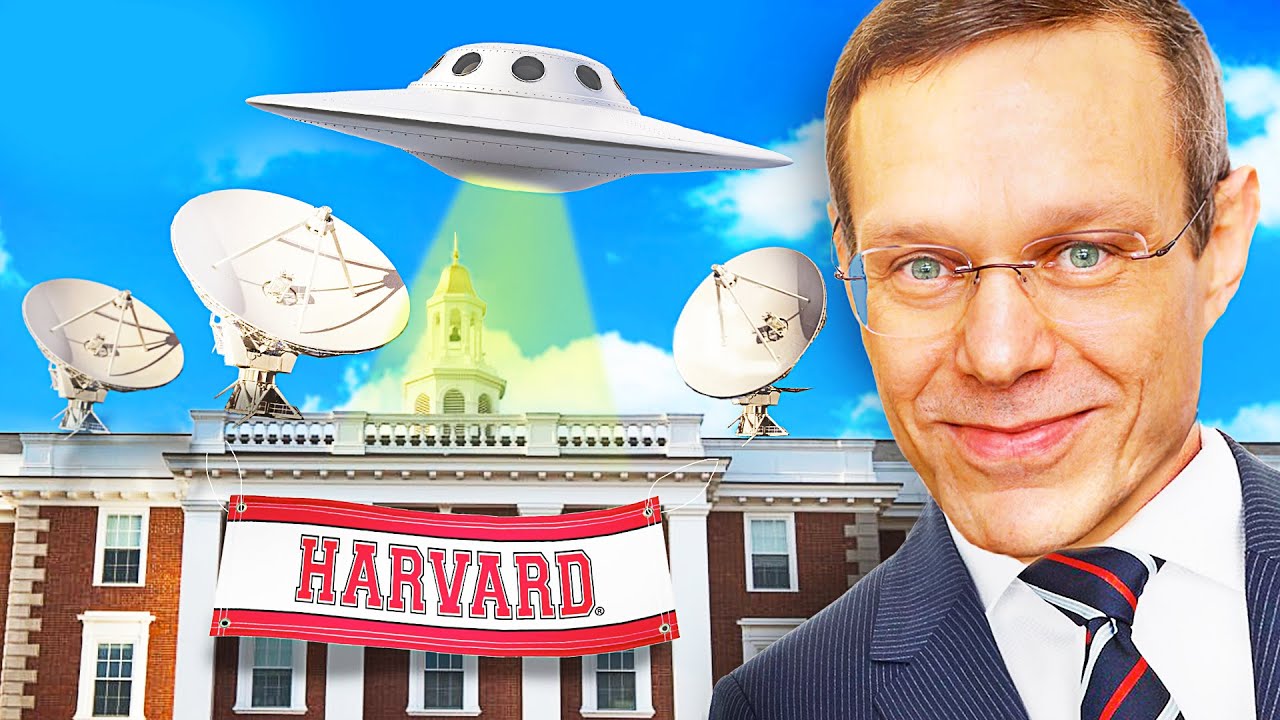
The episode is a conversation with Harvard astrophysicist Dr. Avi Loeb about his Galileo Project, a systematic scientific effort to study unidentified aerial phenomena (UAPs) using dedicated, publicly accessible instrumentation — motivated by the inadequacy of government-controlled data and the historical stigma that has kept mainstream scientists away from the topic.
The Galileo Project and why it exists
Loeb is building a multi-sensor observatory on top of the Harvard College Observatory equipped with optical, infrared, radar, audio, and magnetic sensors to continuously monitor the sky and classify objects — birds, drones, or anomalies — using AI algorithms.
The project is a direct response to the fact that the U.S. government controls all the best data on UAPs and decides what to release; public reports (such as the June 25, 2021 Pentagon assessment) rely on military sensors designed for combat, not science, and are insufficient for publishing rigorous papers.
Loeb emphasizes that science requires instrumentation you fully control — not eyewitness testimony, pilot anecdotes, or classified military footage — and that the Galileo Project is designed to produce open, transparent data that any scientist can analyze.
‘Oumuamua as the catalyst
Loeb’s interest in extraterrestrial questions was triggered by the 2017 discovery of ‘Oumuamua, the first known interstellar object, detected by the Pan-STARRS telescope in Hawaii.
The object was roughly football-field-sized, lacked a cometary tail, and showed non-gravitational acceleration (it changed speed erratically) — features that did not match any known asteroid or comet.
Loeb proposed it might be a light sail — a thin structure propelled by sunlight — which implies artificial origin, because nature does not produce such thin, flat solid objects.
He drew an analogy to a caveman finding a cell phone: without curiosity and better instruments, the object would be dismissed as “a rock we haven’t seen before.”
A later Pan-STARRS discovery turned out to be a forgotten NASA rocket booster from 1966 that also used solar radiation for propulsion — showing that light-sail-like behavior is something humans have produced, strengthening the plausibility of the hypothesis.
Government history with UFOs
The U.S. government’s relationship with UFOs has been inconsistent: Operation Blue Book (1947 onward) was followed by the Robertson Panel (1952), which the CIA pushed to systematically downplay UFO reports through media to avoid public panic.
The Condon Report (1968) ended serious government investigation for decades, until the revelation of AATIP (Advanced Aerospace Threat Identification Program, started 2007, run under Bigelow Aerospace) surfaced in 2017 via journalist Leslie Kean.
Loeb reads the 2021 Pentagon report as having two competing voices — one wanting to disclose more, another resisting — and argues the public cannot rely on a “semi-trustworthy” government to reveal the truth.
Scientific modesty and the Fermi paradox
Loeb argues against human hubris: most stars formed billions of years before the sun, so it is statistically likely that intelligent civilizations predate us.
He rejects Enrico Fermi’s famous “Where is everybody?” question as presumptuous — comparing it to sitting at home and concluding you have no neighbors because no one knocks on your door. The answer is to look with proper instruments.
He suggests a possible resolution to the Fermi paradox: advanced civilizations may retreat into virtual realities (“metaverse” style), and we might detect them only through technological trash they deposit in space — analogous to going through a celebrity’s garbage.
He also proposes searching for city lights on the night side of exoplanets like Proxima b (orbiting Proxima Centauri) using the James Webb Space Telescope — artificial illumination would be a technosignature.
On human observers, consciousness, and related claims
Loeb is skeptical of using people as detectors — including fighter pilots like David Fravor (who reported the 2004 “Tic Tac” incident off San Diego) — because subjective testimony is not scientifically controlled, even if the witnesses are credible.
He is aware of researchers like John Mack (former Harvard psychiatry department head, who studied alien abductees) and Gary Nolan (Stanford) who explore a possible link between UAP sightings and the observer’s brain — for instance, enlarged caudate nucleus and putamen in some pilots — but he cautions that correlation could reflect hallucination rather than perception, and insists on instrument-based validation.
Space exploration, AI, and “technological kids”
Loeb believes the first evidence of another civilization will be equipment (probes or AI), not living creatures, because biology cannot easily survive cosmic radiation in interstellar space.
He is critical of space tourism and large-scale Mars settlement plans (such as Elon Musk’s), calling proposals to terraform Mars by detonating thousands of thermonuclear weapons over its poles unrealistic.
He envisions humanity’s future in space as sending AI-driven “technological kids” — autonomous systems, analogous to self-driving cars — rather than fragile human bodies.
Physics, antigravity, and what we don’t know
Asked about the physics of UAPs, Loeb urges modesty: like a caveman confronting a cell phone, we should not pretend to understand something before studying it properly.
He notes that antigravity is not purely speculative — the accelerating expansion of the universe demonstrates a real repulsive gravitational effect — but whether it can be harvested technologically is unknown.
He mentions that colleagues like Eric Weinstein (who joined the Galileo Project) speculate about advanced mathematical structures in UAP behavior, but he treats these as open questions, not answers.
Why he does it despite the stigma
Loeb frames his willingness to endure ridicule from conservative colleagues in terms of a military metaphor: sometimes a soldier must lie on barbed wire so others can pass through.
He invokes Blaise Pascal’s wager logic — the implications of finding extraterrestrial intelligence are so enormous that dismissing the question outright is irrational.
His closing message is that scientists should act like curious children exploring the world, not cautious “adults in the room,” because the stakes for humanity are too high to ignore.