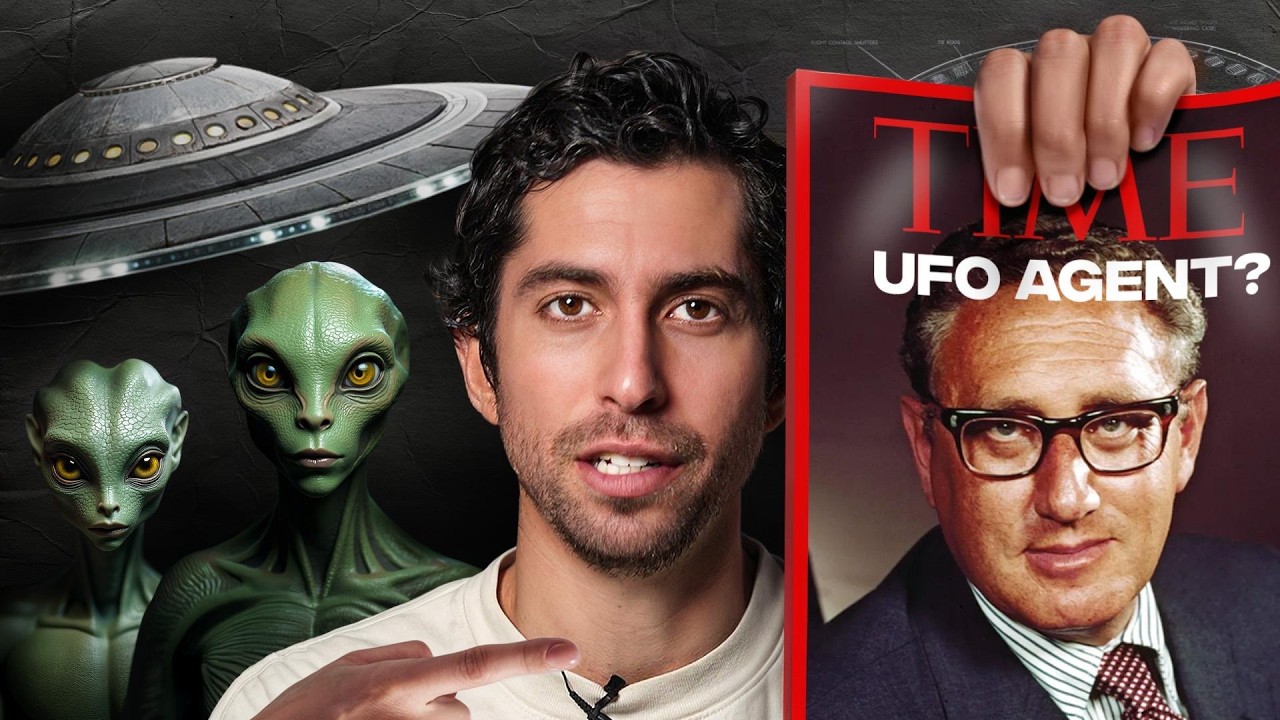
This episode investigates the claim that Henry Kissinger, one of the most powerful and controversial figures in 20th-century American foreign policy, oversaw or was deeply involved in a secret UFO crash retrieval program — a claim rooted in circumstantial evidence, intelligence community connections, and testimony from the widow of a classified scientist.
The Kingman Crash and Dr. Eric Wang
In 1953, engineer Arthur Stansel — a decorated WWII veteran with an impeccable record — was pulled from nuclear testing work at the Nevada test site and flown to a classified location near Kingman, Arizona, where he was shown a crashed disc-shaped craft roughly 30 feet in diameter, buried in sand, with no visible damage and a small open hatch, alongside 4ft tall humanoid bodies in a nearby tent.
Stansel’s presence at the Nevada test site is confirmed by declassified Operation Upshot-Knothole records.
Former intelligence official Chris Melon later confirmed the craft had been recovered and studied for decades.
Stansel reported to Dr. Eric Wang, head of the Special Studies Department at Wright-Patterson Air Force Base — a figure who left almost no public trace despite having a research facility named after him at the University of New Mexico.
UFO researcher William Steinman eventually traced Wang through an obituary, discovering he was born in Vienna in 1906, graduated from the Vienna Technical Institute, and may have been a contemporary of Victor Schauberger, the Austrian scientist rumored to have developed anti-gravity propulsion for the Nazis.
Wang immigrated to the US before WWII, lectured at the University of Cincinnati, led Special Studies at Wright-Patterson, and in 1956 relocated his department to Sandia Laboratories at Kirtland Air Force Base in New Mexico.
Steinman tracked down Wang’s widow, Maria, who confirmed her husband worked on classified projects involving non-human technology and that he had reported directly to Henry Kissinger — who she said was deeply involved in the flying saucer program and had visited their home.
Kissinger’s Early Career: Army Intelligence and Nazi Tech Recovery
Kissinger was born in 1923 in Germany to a Jewish family and immigrated to the US in 1938; he was drafted into the US Army during WWII, fought in major battles, witnessed a concentration camp liberation, and was recruited into the Counter Intelligence Corps (CIC).
The CIC was deeply embedded in classified operations including the Manhattan Project and is frequently mentioned in Roswell and Majestic 12 accounts.
At age 22, Kissinger was entrusted with overseeing the town of Bensheim, then assigned to Oberammergau in the Bavarian Alps — the site of a secret Messerschmitt weapons facility where the Nazis developed jet planes and radio-controlled missiles.
This was a crucial location for Operation Paperclip, the program that secretly imported over 1,500 Nazi scientists; Wernher von Braun himself had been apprehended there.
SS General Hans Kammler, who oversaw both concentration camps and the Nazis’ most advanced weapons programs, had ordered approximately 400 scientists to relocate there.
Persistent rumors held that exotic anti-gravity and flying saucer experiments were conducted at Oberammergau, with Victor Schauberger allegedly developing a craft that defied conventional physics.
CIC agents interrogated Schauberger for nine months, reportedly considering his discoveries more important than Nazi nuclear research.
Another CIC agent, Neil Gershimer, later tricked Schauberger into signing his work over to the US; the intellectual property ended up at Brookhaven National Labs.
Given that CIC agents in the same organization and field of operations had already gathered this intelligence, and given Kissinger’s credentials — fluency in German, experience interrogating ranking Nazis, and his position at the center of sensitive intelligence gathering — it is reasonable to conclude he was at least peripherally involved in managing the transition of Nazi scientists and their secrets into US custody.
Harvard, the CIA, and the Cold War Intellectual Network
Kissinger enrolled at Harvard in 1947 while maintaining ties to the CIC; he graduated in 1950 as the Cold War intensified.
Harvard was deeply intertwined with the national security state:
President James Conant was a key Manhattan Project figure and top government adviser on nuclear technology.
Astronomer Dr. Donald Menzel was a leading public UFO debunker, yet astrophysicist Dr. Béatrice Vallet claims he ordered the destruction of one-third of Harvard’s astronomical photographic plates from the 1952 Washington DC UFO flap — and Menzel was named in the MJ-12 documents as part of Truman’s secret UFO research panel.
Physicist Lewis Branscomb, who earned his PhD from Harvard in 1949, allegedly offered Condon Committee chair Edward Condon a deal: help bury the UFO question and get his security clearance back.
Kissinger didn’t just theorize about psychological warfare — he practiced it, authoring reports and launching international seminars at Harvard backed by the intelligence community to cultivate foreign intellectuals as American allies.
He maintained direct ties to CIA chief Alan Dulles and served as a consultant to the Psychological Strategy Board (PSB) and its successor, the Operations Coordinating Board — high-level programs designed to unify psychological warfare across US agencies.
Declassified CIA memos from 1952 show the PSB was deeply concerned about UFOs as both a psychological warfare vulnerability and an air defense threat, with over 1,500 reports logged and 20% unexplained.
PSB member Philip J. Corso later claimed in The Day After Roswell that alien tech had been recovered and reverse-engineered.
Another PSB figure, Douglas Jackson, later became head of Life magazine and withheld the Zapruder film’s moving footage for over a decade after acquiring it.
Kissinger’s Rise Through Elite Policy Circles
In 1955, Kissinger was invited by McGeorge Bundy to join the Council on Foreign Relations (CFR), directing a study group on nuclear war and foreign policy.
He was briefed by Robert Oppenheimer and the group was chaired by Gordon Dean, former head of the Atomic Energy Commission.
The resulting book, Nuclear Weapons and Foreign Policy, was called “extraordinarily well-informed” by Oppenheimer and launched Kissinger into public prominence.
CFR study groups included figures like Eisenhower, CIA director Allen Dulles, and Richard Bissell — who spearheaded the U-2 and SR-71 programs, knew Area 51, and was named by presidential adviser Harold Malmgren as the person who briefed him on otherworldly technology.
Kissinger was then recruited by Nelson Rockefeller, serving on his expert panel to counter Soviet influence and later directing the Rockefeller Brothers Fund special studies project, which included Edward Teller.
Teller, the hydrogen bomb’s inventor, was named in a report by Australian nuclear physicist Harry Turner (who led all nuclear efforts for Australia’s Joint Intelligence Organization) as working with others on controlling gravity.
By the late 1950s, Kissinger was a tenured Harvard professor, trusted adviser to the military and government, and a rising public intellectual — all while Maria Wang’s claim places him at the center of the UFO program through her husband’s work at Wright-Patterson and Sandia Labs.
Sandia Labs, Kirtland AFB, and the Bluegill Triple Prime Connection
A redacted history of Sandia Laboratories notes that Don Carter — later a Nixon administration adviser — organized interdisciplinary seminars featuring international experts including Henry Kissinger while overseeing advanced research at Kirtland Air Force Base.
In 1962, during the Bluegill Triple Prime nuclear test in the Pacific, one detonation reportedly downed a UFO; the craft was recovered and sent to the Albuquerque operations office overseeing Los Alamos and Sandia Labs at Kirtland.
This office was headed by Lawrence Preston Gies — Jeff Bezos’s maternal grandfather — who worked for the Atomic Energy Commission.
Navy deck logs confirm anomalous debris came out of the blast plume and was recovered.
Harold Malmgren, who was in charge of White House efforts around the test, stated that Gies was directly involved in reverse engineering recovered craft during this period.
This ties another UFO crash retrieval to Sandia Labs, where Dr. Wang worked and where Kissinger had a documented connection.
The MJ-12 Documents and Their Corroboration
The MJ-12 documents — a collection of over 3,000 pages leaked over decades — allege the existence of a secret committee formed by Truman in 1947 to handle the extraterrestrial issue, including figures like Vannevar Bush, Gordon Gray, Donald Menzel, and Eisenhower.
While some documents may be forgeries or disinformation, key details have been independently corroborated.
A 1995 leaked MJ-12 document references a June 28, 1961 meeting between JFK and CIA director Allen Dulles about MJ-12 and psychological warfare — a meeting that was completely unknown to the public until the 2022 JFK files release confirmed Dulles had indeed met with JFK twice on that exact date.
Other documents contain obscure, hard-to-fake markings and margin notes that experts have analyzed as authentic.
The broader logic is consistent: just as the government formed classified interdisciplinary groups to manage the nuclear threat, it would logically do the same for an extraordinary event like Roswell.
Kissinger’s career trajectory places him squarely within the network described in MJ-12 documents — from CIC involvement in early crash retrievals, to Harvard intelligence ties, to CFR study groups alongside Oppenheimer and Gordon Dean, to Rockefeller’s special studies project.
Detlev Bronk, president of the Rockefeller Foundation, was named as one of the MJ-12 members, further linking Rockefeller circles to the alleged program.
Some researchers suggest MJ-12 evolved from a small Truman-era committee into a more structured program under Eisenhower, with elite think tanks like the CFR and Rockefeller projects serving as its intellectual backbone — and that private industry was brought in to compartmentalize reverse engineering work away from congressional oversight.
The Kennedy Era and the 303 Committee
Kissinger consulted for the Kennedy administration on nuclear weapons in Germany while remaining close to Rockefeller.
Two months after the Bay of Pigs disaster in June 1961, Kennedy requested a full briefing on MJ-12 activities from Dulles — specifically regarding their role in Cold War psychological warfare — before Dulles was dismissed in November.
This raises the question of whether JFK’s decision to clean house at the CIA overlapped with an investigation into MJ-12.
The 303 Committee (and its predecessors, the 5412 unit and the 40 Committee) was the secret interagency group overseeing all covert operations, with members including the National Security Adviser, senior CIA officials, and representatives from State and Defense.
Kissinger was involved with this committee, and some researchers suggest these official names may have been interchangeable with MJ-12 or its successors in the UFO world.
The committee’s structure — designed to shield the president through plausible deniability — mirrors the compartmentalization that seems to have governed UFO secrecy.
The Nixon White House and Operation Moon Dust
When Kissinger became National Security Adviser under Nixon in 1969, he controlled the NSC’s processes so thoroughly that he decided what Nixon reviewed, bypassing bureaucratic dissent.
In 1968, he wrote: “The only way secrecy can be kept is to exclude from the making of the decisions all those who are theoretically charged with carrying it out” — a philosophy that mirrors UFO compartmentalization.
Actor Jackie Gleason, a UFO enthusiast whose house was built to resemble a flying saucer, claimed Nixon once took him to see alien bodies at a secret facility — a story that, whether true or not, suggests Nixon had some level of access to UFO programs, meaning Kissinger likely heard about it.
Harold Malmgren was brought into the Nixon administration in 1971 and acted as a check on Kissinger’s power — and since Malmgren had been briefed on otherworldly technology by Richard Bissell and had seen evidence from the Bluegill Triple Prime recovery, it is likely Kissinger had a similar level of awareness.
In January 1977, just before leaving office, Kissinger sent a telegram to the US embassy in Ottawa requesting a report on “possible returned space objects” under the subject line “Moon Dust.”
Operation Moon Dust was a Cold War Air Force program to recover and analyze foreign space debris, but declassified documents show its remit extended to unidentified objects.
Related documents describe recovered spherical objects in New Zealand farmland, a fireball and silent aircraft near a Bolivian crash site, and a 1957 UFO event in Afghanistan sent to Wright-Patterson that rivals Roswell.
These documents show striking similarities to procedures outlined in MJ-12 documents and what is now known about legacy UFO programs.
Kissinger’s Enduring Legacy and the Gatekeeper Question
Kissinger’s realpolitik approach achieved notable diplomatic successes — opening China, advancing arms control through SALT I — and he remained a trusted confidant of both Vladimir Putin and Chinese leadership for decades.
His exchange with Putin in the 1990s is telling: when Putin said he got his start in intelligence, Kissinger replied, “All decent people get their start in intelligence. I did too.”
President Xi Jinping called him an “old friend” and said US-China relations will always be linked with his name.
Modern UFO whistleblower David Grush has suggested someone like Dick Cheney served as a gatekeeper of the UFO program; if such a role existed before Cheney, Kissinger is a plausible candidate.
Whether or not Kissinger was exactly what Maria Wang described, the circumstantial case — his CIC background, intelligence ties, connections to figures linked to UFO programs, documented presence at institutions where crash retrievals were studied, and his final telegram about Moon Dust — makes his involvement very plausible.
The deeper question the episode raises is whether such a gatekeeper role still exists, who occupies it now, and whether the public will ever know.