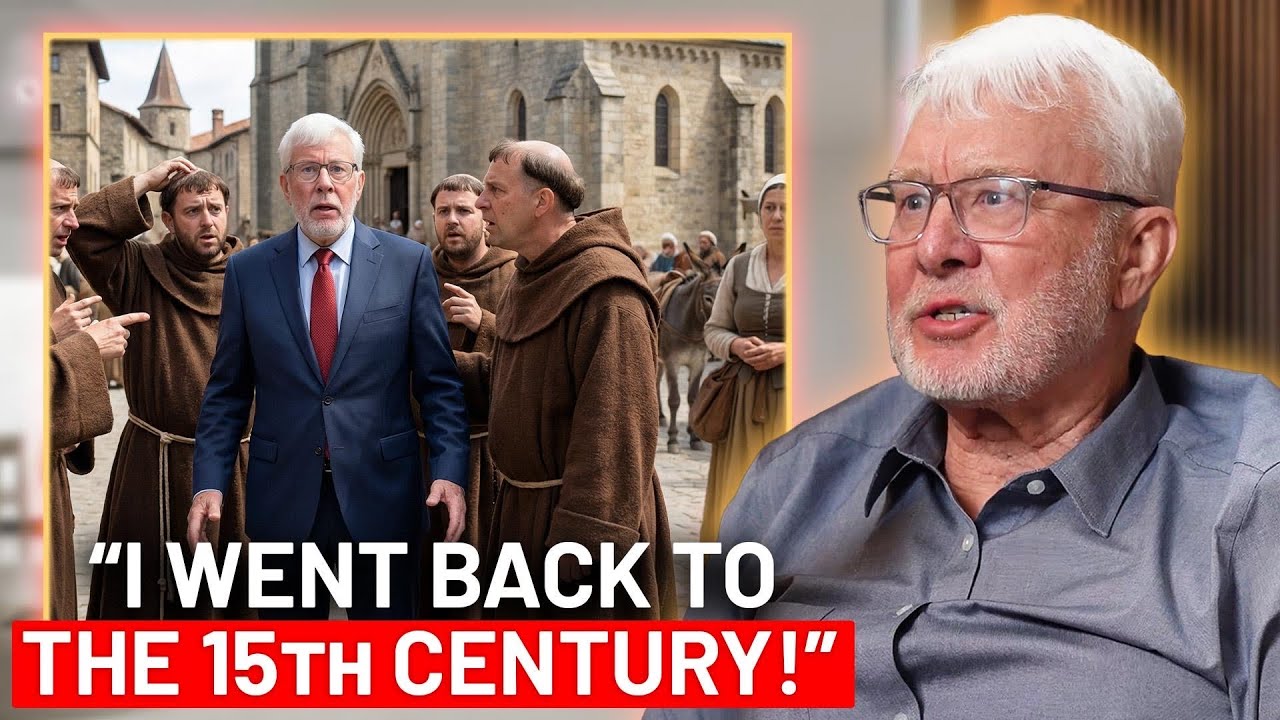
Ralph Moat Larson is a former CIA and Department of Energy intelligence officer who served for over two decades in some of the most consequential national security roles of the late 20th and early 21st centuries, including as CIA Chief of Station in Moscow and as Director of Intelligence and Counterintelligence at the DOE. He worked directly with figures like CIA Director George Tenet, NSA Director Michael Hayden, FBI Director Robert Mueller, President George W. Bush, Vice President Dick Cheney, and even had a brief observational encounter with Vladimir Putin. But what makes Larson extraordinary is not his intelligence career—it is his claim, described with the same matter-of-fact precision he brought to espionage, that he has traveled in time, encountered the Virgin Mary on multiple occasions, received prophetic numerical downloads, and experienced mystical states indistinguishable from waking reality. His book A State of Mind weaves these two threads together: a life spent at the threshold of nuclear apocalypse and a parallel life of deep spiritual transformation.
-
Larson’s intelligence career and its spiritual undertow
- He began at West Point in the 1970s, served on the Czech border confronting Soviet forces, then joined CIA in 1983, spending nine tours overseas across Europe, the Soviet Union/Russia, and the Middle East.
- He describes three phases: classic Cold War espionage (1983–1991), post-9/11 counterterrorism focused on weapons of mass destruction (where he briefed President Bush daily during acute threat periods), and later service at the Department of Energy (2005–2008).
- A pivotal moment came three weeks before the 2003 Iraq invasion when he briefed Bush on the location of Abu Musab al-Zarqawi’s camp in northeast Iraq. When Bush asked him directly what he should do, Larson—overruling his instructions to say nothing—told the president he would bomb it. He describes this as a moment where personal integrity overrode institutional scripting.
- He was Moscow station chief during the 1993 Yeltsin coup, when Russian intelligence actually sent armed teams to protect CIA officers from being taken hostage—an extraordinary episode of cooperation between adversaries.
- He was deeply skeptical of the Iraq War’s intelligence basis, believing it stemmed from bad sources rather than deliberate deception, and considered resigning.
-
The mystical experiences: numbers, dreams, and prophecy
- As a young, nihilistic Army officer at Fort Knox in the late 1970s, Larson began having vivid precognitive dreams. The most striking was a dream of Anwar Sadat’s assassination on September 6, 1981—including details like the timing, the gunmen pulling weapons from cloaks, and even the presence of Ayman al-Zawahiri (who would later become al-Qaeda’s leader)—all of which matched reality when he read about it the next day.
- During this period, he had a dream in which the number 747 appeared prominently, followed by a cascade of numbers that were all multiples or variations of three (3, 6, 9, 12, 18, 27, 40). He has spent decades trying to understand their meaning, consulting physicists and religious scholars.
- The number 747 later took on eerie resonance: the Roswell crash occurred on July 7, 1947 (7/7/47), and a South African nuclear test suspected to be an Israeli collaboration was internally labeled the “747 incident.”
- His German girlfriend at the time independently dreamed of the exact same numbers (3, 6, 9, 49) appearing on a desk, without any prior knowledge of his dream—a corroboration he considers deeply significant.
- At age 40, on a train from Zurich to Vienna, Larson experienced what he describes as a direct, terrifying encounter with the presence of God. Time seemed to slow, his body grew heavy, and he received a message: “One church. The old and the new are one. Swallow them whole. Read it as a child.” He interpreted this as instruction to read the Bible cover to cover without overanalyzing, and to stop criticizing organized religion’s sins while maintaining faith in the underlying community of believers.
-
The Mount Athos time travel experience (1991)
- In 1991, Larson traveled to Mount Athos, Greece—an Orthodox monastic peninsula—ostensibly on CIA business to investigate a Russian intelligence officer posing as a monk. During an all-night church service, he fell asleep on a stone chair and entered what he describes as a profoundly vivid dream state.
- He first found himself in 1800s Paris, where he encountered a suffering woman in a brothel whom he later identified as the Virgin Mary, and then met a character from Hermann Hesse’s Steppenwolf named Harry Müller, who told him to go to Mount Athos to atone.
- He then experienced time moving backward with each step of his journey—from the 1800s to the 1400s—arriving in medieval Mount Athos where he presented himself to the monastic authorities as “Odius Maximus,” a mystic seeking refuge. The monks, led by a Father Gabriel, took him in despite their reservations.
- For what felt like months in the dream, he lived as a monk: tending grapes, cleaning dishes, fasting, praying, and eventually becoming a recluse in the wilderness. He describes learning to fly—a manifestation he connects to spiritual openness and ego dissolution—and burning his hut, as was the tradition for recluses seeking ever-greater detachment.
- He felt genuinely trapped, unsure he could return to his 20th-century identity. He confided his true situation to a young monk named Evagrius, who responded with calm wisdom and encouragement.
- The experience culminated in three nested dreams-within-dreams: one involving a barber-shop-style number draw, another involving seven doors that people walked through according to their numbers (with fine clothes for some and rags for others), and a third in which he walked across water toward salvation but was swept away when he tried to save an old woman (again, the Virgin Mary figure).
- Upon waking, he saw a red light moving through the church, which a monk named Timotheus told him was associated with sightings of the Virgin Mary. Timotheus gave him three books on the subject.
- Years later, when he returned to Mount Athos for a month-long visit, he was led by a series of coincidences to a remote skete (monastic settlement) named after Maximos of Kafkasallavia—a real historical figure known as a flying monk who burned his huts. Larson had invented the name “Odius Maximus” in the dream with no knowledge of this saint.
-
Encounters with the Virgin Mary
- Larson describes three major encounters with the Virgin Mary across a seven-year cycle:
- 1991, Mount Athos: The initial dream encounter in the brothel in Paris, followed by the light in the church.
- 1998, Paris: While on a CIA trip, he had a dream by a river in which an old woman in a brown cloak sat beside him. When it began to rain brown, purifying dirt, she turned toward him and he recognized her as the Virgin Mary. He woke to find her physically present in his hotel room as a radiant, indescribable light. She communicated non-verbally, conveying a message of grief over the world’s suffering—especially women and children in war—along with hope. She instructed him to write a letter to the Pope. He experienced a state of ecstasy he describes as beyond any physical sensation.
- 2005: He was back in Paris on the night Pope John Paul II died, which he connected to the seven-year cycle, though he did not have a direct encounter that year.
- He wrote the letter to the Pope describing all his experiences, including the numerical downloads. The Vatican responded with a letter that appeared to have a personal touch from John Paul II. He shared the same letter with the Orthodox Patriarch in Istanbul, who also responded warmly.
- He emphasizes that the Virgin Mary’s message was always about God’s will, not her own, and that her central instruction was: “Don’t reach. God lies within you. Don’t strive. You have no needs.”
- Larson describes three major encounters with the Virgin Mary across a seven-year cycle:
-
The physics of mysticism and the nature of time
- Larson has consulted with physicists about his experiences and favors an explanation rooted in the idea that our universe—the “big bang universe”—is a universe of motion, where time is a function of mass and motion. He speculates that there may exist a “universe at rest” beyond or alongside ours, where time does not exist and where all events are eternally present.
- In this framework, heaven and hell are not places but states of mind—proximity to or separation from God. Prophecy, time travel, and mystical experiences become possible because they originate from or access this timeless domain.
- He connects this to Einstein’s insight that “time is but an illusion” and to the transfiguration of Christ, which he sees as a deliberate staging between earthly and post-earthly existence.
- He is careful to note that he is speculating philosophically, not claiming scientific proof, and that the pattern and consistency of his experiences across decades is itself a form of authentication.
-
Department of Energy, UFOs, and government secrecy
- As Director of Intelligence and Counterintelligence at DOE (2005–2008), Larson was responsible for some of the nation’s most sensitive nuclear secrets. He describes the DOE as a hybrid organization with three components: energy research, pure science, and the National Nuclear Security Administration (which manages nuclear weapons).
- He was never briefed on UFO-related matters during his tenure, despite the DOE’s known connection to nuclear sites where UFO incursions have been repeatedly reported (Malmstrom, F.E. Warren, and others). He finds this absence notable but not proof of concealment—it may reflect compartmentalization.
- He describes a DOE hazing ritual in which new high-level political appointees were brought into the deepest vaults and told, with elaborate seriousness, that the government had recovered alien bodies and technology from Roswell and that they were being recruited for an expedition to the aliens’ home planet. The briefing was so convincing that it raised genuine questions about how the government would handle disclosure.
- He is skeptical of claims that the government is running reverse-engineering programs but gives high credence to the well-documented pattern of UFO appearances around nuclear facilities worldwide. He speculates that if non-human intelligence is monitoring us, it may be concerned about our crossing thresholds of knowledge—particularly in nuclear physics, AI, and biotechnology—that could have implications beyond our understanding.
- He is firmly against excessive government secrecy, calling it corrosive to democracy, and says that if he knew the government had evidence of extraterrestrial life, he would go to the press.
-
Faith, sacrifice, and the trajectory of human civilization
- Larson’s central spiritual conviction is that the path forward for humanity runs through selflessness and sacrifice, not domination and control. He sees this as the lesson of Christ, Gandhi, Tolstoy, and Mandela—figures the world admires but does not emulate.
- He views the apocalypse not as a literal end-time event but as a recurring human tendency toward self-destruction through the misuse of God’s gifts—nuclear weapons, AI, biotechnology. His role, as he understands it, is that of a watchman in the tradition of Ezekiel: his job is not to prevent the apocalypse but to warn.
- He is deeply concerned about the cultural effects of technology—virtual reality, AI companions, social media—on individual identity and the ability to distinguish created reality from actual reality. He sees this as a spiritual crisis as much as a technological one.
- He places his greatest hope in younger generations pushing beyond the boundaries of current scientific and philosophical paradigms, just as Einstein did as a patent clerk.