-
Jesse Michels interviews Dave Rossi, a former construction worker with no formal scientific training who, after a profound encounter with a blue plasma-like being during the COVID-19 lockdowns, developed an advanced self-taught understanding of quantum physics, extended electrodynamics, and exotic propulsion — knowledge that has since impressed senior Navy scientists, Hal Puthoff, and Eric Davis.
- Before the encounter, Rossi was a blue-collar construction worker running a small, evidence-based UFO podcast with no background in science — he had failed math repeatedly in high school.
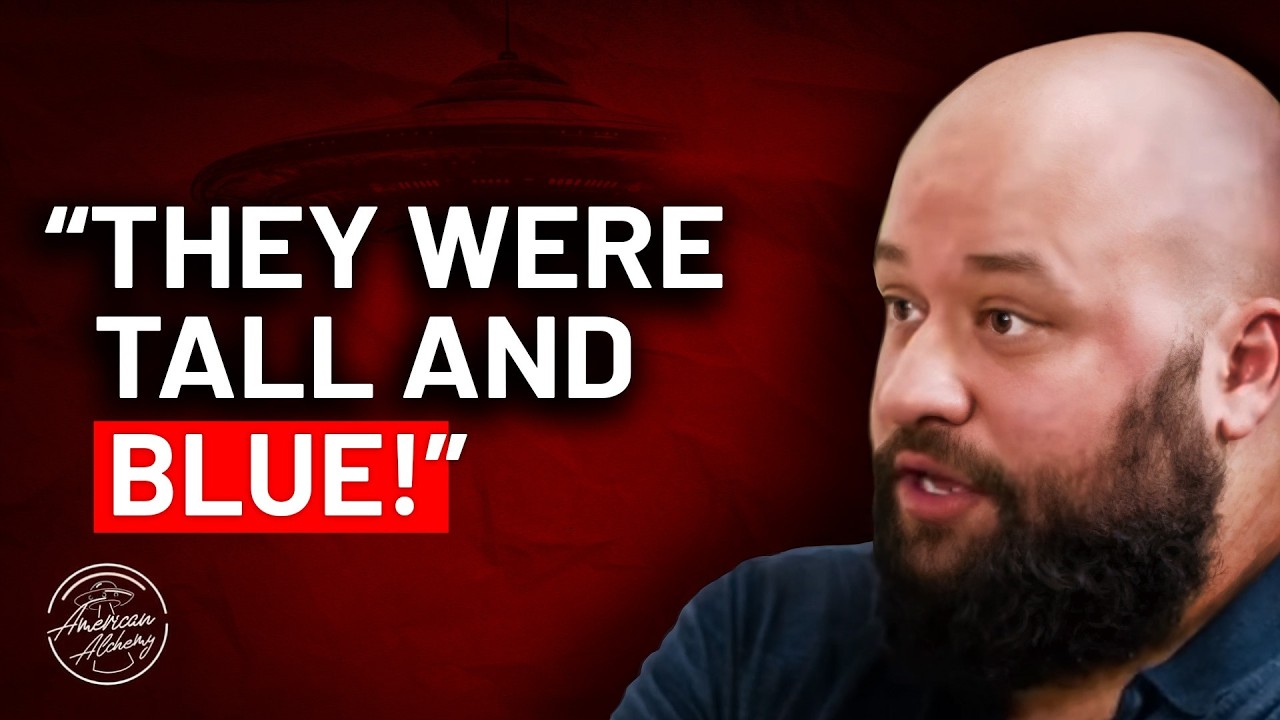
- The experience involved a tall, blue, humanoid energy being made of plasma-like substance that showed him, in a visual and intuitive way, the existence of longitudinal scalar waves — described as slinky-like structures permeating all of space — which became the foundation of his subsequent research.
- Afterward, he experienced an overwhelming drive to study electrical engineering and quantum physics, spending two years in intense self-study of Soviet-era papers, North American literature on zero-point energy, and the works of figures like Nikola Tesla, Gabriel Kron, E.T. Whittaker, Hal Puthoff, and Eric Davis.
- He built experimental devices — including ring superconductor setups — that produced effects consistent with extended electrodynamics theory, and began networking with individuals in the defense industry and private military contracting who privately encouraged his work.
- His knowledge was noticed by credible scientists; he was invited to present to individuals who recognized the physics and engineering validity in his ideas, and he now consults privately for groups working in exotic physics.
-
Rossi’s core scientific framework is extended electrodynamics, which holds that classical Maxwellian electrodynamics is incomplete because it assumes flat spacetime and only accounts for transverse (Hertzian) electromagnetic waves, while ignoring scalar fields and longitudinal wave types that become accessible when spacetime is curved.
- In standard U(1) electromagnetism, electric and magnetic fields are perpendicular to the direction of wave propagation, and signals decay over distance. Extended electrodynamics introduces scalar potentials that allow longitudinal waves — where the field and propagation direction are parallel — which do not attenuate normally and can enable exotic effects.
- The key insight is that potentials (the four-vector potential) are more fundamental than fields themselves, as demonstrated by the Aharonov-Bohm effect. By manipulating vector and scalar potentials electromagnetically, one can induce topological curvature in spacetime that flat-spacetime models cannot access.
- Rossi illustrates this with Feynman’s observation that when charging a capacitor, sparks appear at the edges of the gap rather than where charge is applied, implying kinetic momentum in the quantum vacuum — energy that standard models ignore.
- When spacetime is curved (through spinning capacitors, polarized superconducting lattices, or high voltage), phenomena like cold electricity (currents that cause frostbite rather than burns), negative entropy (negentropy), and low-energy nuclear reactions become possible — effects that violate the second law of thermodynamics under standard assumptions but are consistent in an open-system framework that includes the quantum vacuum.
-
Curving spacetime through engineering is the practical mechanism Rossi emphasizes, achievable through several methods:
- Mechanical rotation of capacitors induces local spacetime curvature.
- Polarized superconducting lattices — when the symmetry of a superconductor’s crystal lattice is broken through electromagnetic polarization, electrons move nonlinearly, coupling electromagnetism to gravity.
- High voltage (hundreds of thousands of volts) polarizes the local vacuum, enabling effects on biological systems (enhanced plant growth), communication, and propulsion.
- Geometric structuring of materials — ring superconductors, conical or cylindrical shapes — acts as a geometric inductor that couples transverse electromagnetic waves to the scalar field, matching the vortex-like (caduceus or double-helix) geometry of longitudinal waves.
- Rossi references Salvatore Pais’s Navy patents on inertial mass reduction, which describe coupling spin with electromagnetic charges to break the Schwinger limit (the threshold at which the vacuum becomes nonlinear), enabling mass reduction and exotic propulsion.
-
The Lorentz regauging of Maxwell’s equations is identified as a critical historical truncation that removed scalar potentials from mainstream physics, effectively eliminating the mathematical framework needed to describe these phenomena.
- Oliver Heaviside simplified Maxwell’s quaternions into vector calculus accessible to engineers of the era, but this process discarded the scalar component.
- Heinrich Lorentz then performed “symmetrical regauging,” setting the sum of vector and scalar potentials to zero — not denying their existence but declaring they had “no physical significance.”
- Rossi compares this to receiving a 12-slice pizza and being told only one slice exists — the other eleven are ignored. This truncation stagnated mainstream particle physics by eliminating the framework for zero-point energy, longitudinal waves, and vacuum polarization.
- The full quaternion formulation of Maxwell’s equations, which includes scalar potentials, was known but suppressed or ignored, and its recovery is central to extended electrodynamics.
-
Superconductors play a central role in Rossi’s framework, not through standard BCS (Bardeen-Cooper-Schrieffer) theory but through the overlooked role of lattice holes — the spaces in the crystal lattice where angular momentum is quantized.
- A 1992 paper by Douglas Torr and Ning Li showed that quantization of angular momentum in superconductors resides in the lattice holes, not in Cooper pairs as BCS theory claims.
- By polarizing the lattice (breaking its symmetry), one induces nonlinear electromagnetic effects that couple to gravity — enabling manipulation of light, gravitational effects, and potentially inertial mass reduction.
- Rossi references Niels Bohr’s view that superconductors are “macroscopic atoms” — they exhibit quantum coherence at scales far above the Planck level, and when engineered with the right geometry (rings, cones), they can tap vacuum fluctuations.
- Topological insulators like barium titanate and magnesium bismuth (high-k dielectrics also used by Townsend Brown in anti-gravity experiments) are materials that, when pulsed with voltage and acoustic resonance, may enable quantum communication that does not decay over spacetime.
-
Gravitational wave generation is discussed through the work of Ning Li, Bob Baker, and Salvatore Pais, connecting to Bob Lazar’s claims about gravity A and gravity B waves.
- Ning Li at the University of Alabama Huntsville reportedly generated approximately 11 kilowatts of high-frequency gravitational waves using superconductors, and described two types: DC gravity (static, depending on magnetostatic field strength) and AC gravity (pulsed, far stronger, with caduceus/double-helix geometry).
- After reporting these results, Li’s email was intercepted from a West Point IP address, she received a classified contract, left the university, and largely disappeared from public view — though Larry Smalley, head of the physics department, later joined her and filed a related NASA patent in 2004.
- Bob Lazar’s gravity A and gravity B waves correlate with Li’s AC and DC gravity, though Rossi believes Lazar was a “limited hangout” — someone with engineering-level knowledge of topological physics but not deep theoretical understanding, released to the public as a controlled disclosure.
- Gravitational waves can be generated by oscillating a quadrupole (two dipoles), and if paired with the strong nuclear force through superconducting systems, could enable spacetime metric engineering — warping space-time for propulsion, creating craft where the interior is larger than the exterior.
-
Practical applications of extended electrodynamics span energy, propulsion, communication, medicine, and surveillance:
- Free energy / over-unity devices: By tapping the quantum vacuum through vector and scalar potentials, devices could output more energy than is input (coefficient of performance > 1), violating the second law of thermodynamics under standard assumptions but consistent in an open-system framework. Rossi speculates this involves extracting virtual particles into real particles.
- Exotic propulsion: Craft that reduce inertial mass could travel through air and water as if those media didn’t exist, by voiding spacetime around the vehicle — consistent with Salvatore Pais’s patents and reported UAP behavior.
- Quantum communication: Hal Puthoff’s work on vector and scalar potential communication uses toroidal geometries to transmit information through topological folding without E and B fields, enabling signals that never decay — potentially useful for underwater or deep-space communication.
- Surveillance: The same potential-based methods can surveil an entire room without cameras, using the quantum vacuum. Rossi knows a government group that has been developing this since the 1990s with “massive success.”
- Medical healing: Peter Garyaev (Nobel-nominated Russian scientist who died under mysterious circumstances) used vector and scalar potentials with sound and light inside wooden pyramids to heal people of depression and physical ailments — a field he called “linguistic wave genetics.” The mechanism involves vacuum polarization to reverse biological entropy, effectively making tissue younger by accessing earlier temporal states stored in the vacuum.
- DNA and consciousness: Rossi speculates that DNA has a third, electrically conductive strand at the Planck scale, existing between the two known helices. This would mean “junk DNA” is not junk and could function as an organic particle accelerator, potentially interfacing with the pineal gland for information download — consistent with Luc Montagnier’s DNA water teleportation experiments and Konstantin Meyl’s work on longitudinal wave resonance with DNA.
-
Temporal displacement and time manipulation emerge as perhaps the most consequential and dangerous implications of this physics.
- Rossi describes longitudinal waves as slinkies where each loop represents a state of entropy or negentropy — like frames in a movie reel. By polarizing the vacuum, one could theoretically access past states of any point in space, viewing history as saved “game states” in the quantum vacuum.
- A newspaper clipping from late-1950s/early-1960s Toronto describes an inventor who created a “death ray” that caused temporal displacement — visitors experienced 25 minutes while 2 hours passed externally. Mossad representatives investigated, and the device was reportedly sold to Israel.
- Thomas Townsend Brown was deeply involved in time travel research and was reportedly president of a secret NASA time travel group based in the Bahamas, according to NASA mission controller Timothy Taylor (as reported in Diana Pasulka’s American Cosmic).
- The Philadelphia Experiment rumors — where sailors were allegedly fused with a ship’s hull — are consistent with temporal displacement effects. Brown was reportedly involved.
- Rossi explains that charge parity inversion in the quantum vacuum is equivalent to time reflection; polarizing time (but not space) can produce time displacement. This connects to precognition — the brain may function as a room-temperature quantum system (as Penrose has suggested with microtubules), accessing future states when survivalally relevant.
- Dean Radin’s work on presentiment is cited as the closest scientific approach to explaining temporal non-locality in consciousness.
-
National security and disclosure dilemmas form a major theme — Rossi and Michels grapple with the tension between the transformative potential of these technologies and their catastrophic weaponization risks.
- Rossi has consulted for Department of Defense contacts who advised him that most people, upon seeing what he knows, would immediately think about weaponization — whereas people like Michels would not.
- A FOIA-leaked document from a Washington D.C. fusion center described psychotronic weapons that can manipulate the human biofield at a distance, including a device that causes uncontrollable defecation. The same methodologies could theoretically be used for healing.
- Rossi knows mutual friends working in private labs where six months of research suddenly produced a weapon — and if such a weapon were obtained by malicious actors, it would be “game over.”
- He believes the emphasis on metamaterials in public discourse is partly a narrative strategy to keep attention on materials science (which is real but incomplete) while diverting attention from the more dangerous underlying theoretical physics.
- Information has been scattered on the internet since its inception in a form that is harmless when dispersed but becomes highly sensitive if compiled in the right order — creating a genuine challenge for open-source researchers.
- Rossi supports the spiritual development emphasis advocated by Danny Sheehan, noting that alleged ET messages to government leaders have consistently stated that humanity must develop spiritually before receiving more advanced technology — because without moral maturity, the technology leads to self-destruction.
-
Rossi’s personal trajectory and the blue being remain mysterious but central to the episode’s narrative.
- He has had three UFO sightings over five years at his former home, including a donut-shaped craft, and still experiences a feeling of connection to the blue being, though he has not seen it again.
- He does not claim to be unique — he believes hundreds of thousands of people worldwide have had similar encounters, and points to children on TikTok who describe “ghosts” teaching them advanced concepts they couldn’t otherwise know.
- He speculates that the blue being may be a form of non-physical intelligence (possibly a Bose-Einstein condensate or plasma matrix) that acts as a facilitator between the quantum vacuum and the physical world — similar to how plasma, as a state between physical and non-physical media, can slow down quantum vacuum fluctuations enough to be accessed.
- Rossi emphasizes that he does not expect anyone to blindly believe him — he has seen undeniable things in private laboratories verified by others, but he welcomes scrutiny from any scientist, including theoretical physicists from traditional academic backgrounds, and is willing to participate in follow-up interviews with experts present.
- He sees himself as part of a larger epistemological paradigm shift in which humanity’s collective consciousness is waking up, the “veil is dropping,” and the convergence of spiritual development with technological capability represents both the greatest opportunity and the greatest danger in human history.