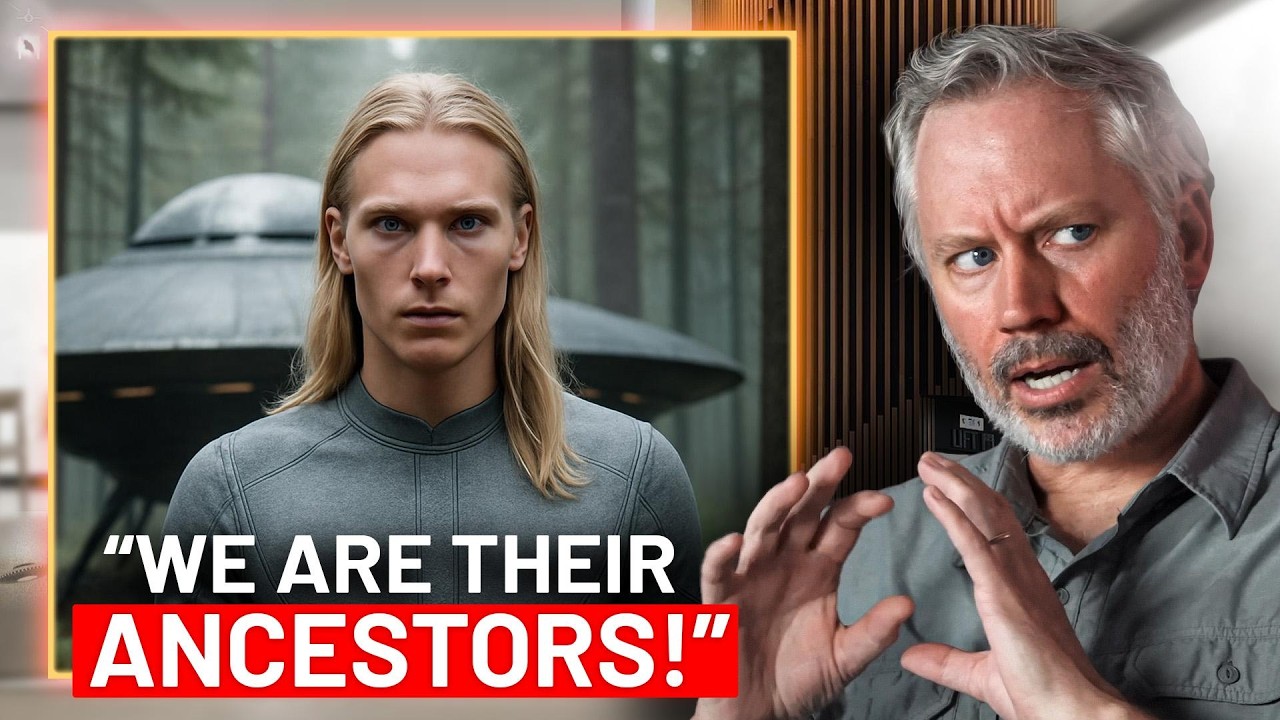
Dr. Michael P. Masters is a biological anthropologist at Montana Tech University who argues that so-called “aliens” are actually humans from the future who have mastered time travel and are returning to study or interact with their own ancestors. He has developed this framework across three books—Identified Flying Objects, The Extratempestrial Model, and Revelation: The Future Human Past—and in this interview he lays out the full case: from evolutionary biology and contactee testimony to theoretical physics and his own personal encounter with these beings.
The Core Argument: Aliens Are Future Humans
Masters contends that the extraterrestrial hypothesis is far less parsimonious than the time-travel hypothesis. The beings described in abduction and contact cases overwhelmingly look humanoid—they breathe our air, speak our languages, can reproduce with us, and share our basic physiology. Convergent evolution producing something this similar on another world is, in his view, vanishingly unlikely.
The “grays” match where human evolution is already heading: larger heads, smaller bodies, reduced noses and ears (less needed for hunting-gathering), and neoteny (adults resembling juveniles of the species). These are documented trends in our own evolutionary trajectory.
A large study of roughly 5,000 contactees and abductees (the Edgar Mitchell/Free Foundation study) found that 52% of reported beings were humanoid, and 85% of those encounters were described as friendly or neutral—consistent with future humans who have a vested interest in their own ancestors’ survival.
The Intertemporal Breeding Program
One of the most persistent themes in abduction cases—especially from the 1970s through the 1990s—is the extraction of human gametes: sperm from males, eggs and fetuses from females. Antonio Vilas Boas (1957) described sexual intercourse with a being he identified as a woman. Barney Hill reported a sperm sample being taken. Jim Penniston, in the 1980 Rendlesham Forest incident, recalled beings saying they were from 8,000 years in the future and needed genetic material to maintain diversity and avoid extinction.
Masters points to real-world data: male sperm counts in the developed world have dropped roughly 60% in 40 years, and testosterone has been declining about 1% per year since the 1980s. If this trend continues, future humans could face severe reproductive challenges, making a program to collect genetic material from the past a matter of species self-preservation.
The fact that these beings can physically reproduce with humans strongly implies shared DNA—something that would be essentially impossible with a species that evolved on another planet.
How the Craft Work: Time Machines, Not Spaceships
Masters argues that many UFOs are not vehicles traveling through space but time machines. The disc/saucer shape is consistent with known theoretical frameworks for manipulating spacetime—specifically Frank Tipler’s 1970s work on rapidly rotating cylinders or ring spheres that drag spacetime and tilt light cones, allowing travel to the past.
This line of physics descends from Einstein’s 1915 general relativity through solutions by Lense-Thirring (frame dragging), van Stockum, Gödel (rotating universe), and Tipler. The Earth itself has been measured to produce a tiny frame-dragging effect.
UFOs are consistently associated with strong electromagnetic fields. Cross-referencing satellite data on electromagnetic and geomagnetic anomalies with historical UFO sightings shows a striking correlation. Masters and researcher Steve Meerman have documented this extensively.
The electromagnetic signature makes sense if these craft generate traversible wormholes or warp bubbles. Eric Wargo (a previous guest on the show) describes how such a portal would appear as a three-dimensional object with volume, not a flat doorway—matching how UFOs are described.
Proximity to these craft produces time anomalies: missing time, accelerated biological growth (grass growing under feet, trees growing faster on the side facing the craft), and temporal displacement. Cases include:
Corporal Armando Valdez in Chile (1970s): vanished for 15 minutes, reappeared with 5 days having passed for him (confirmed by his watch and beard growth).
Travis Walton: shaved before his abduction, had a full beard when he woke up.
Amy Riance: taken from her home, found 790 km away, but claimed she was aboard the craft for 5–7 days—suggesting both spatial and temporal displacement.
Udo Wartena, a minor at the time, was given a tour of a craft and told it used counter-rotating flywheels and electromagnets to create the field needed for propulsion and spacetime manipulation—a description consistent with maglev technology and Tipler-style rotational physics.
Historical Figures Who Reached the Same Conclusion
Masters is not alone. Navy Commander George Hoover, who held top-secret clearance for most of his career, stated that the beings in the Roswell crash were time-traveling humans. Hermann Oberth, the father of German rocketry and Wernher von Braun’s mentor, said UFOs likely don’t traverse large distances in space but jump between spacetime coordinates.
Steven Spielberg may have embedded time-travel hints in Close Encounters of the Third Kind: the WWII pilots who emerge from the mothership haven’t aged at all. According to Deadpool creator Robert Liefeld, Spielberg told him in 1993: “What’s easier to believe—that we are being monitored by aliens from another world, or that we are monitoring ourselves and studying us from the future?”
Tom DeLonge (Blink-182 frontman, founder of To the Stars Academy) has said in a recent Newsweek article: “These things aren’t coming from other planets. These things might be coming through time.”
Even Nikola Tesla-era inventor Thomas Townsend Brown, known for anti-gravity research, privately told confidants his devices were time machines, according to Paul Schatzkin’s book The Man Who Mastered Gravity.
Government Possession and Reverse Engineering
The host raises the question of whether the U.S. government is in possession of crashed or landed time machines. Masters says if the crashed craft are time machines, then yes, absolutely.
David Grusch, the UFO whistleblower, has testified that the government possesses craft with bizarre materials—heavy elements like europium and californium arranged in atomic configurations that make no known sense, in ceramic-metallic honeycomb structures with emergent metamaterial properties we cannot yet replicate.
Masters speculates that the visitors may be “pulling” us toward the technology rather than pushing it—guiding our scientific development so that we eventually build the very machines they arrived in, creating a closed causal loop.
Remote Viewing, Quantum Consciousness, and Time Loops
The CIA/DoD Stargate Program (1972–1995) trained psychic spies to remotely view targets. Many of these viewers began picking up imagery of what they interpreted as alien beings. Masters and the host explore a theoretical connection: if the brain functions as a room-temperature quantum system (as Nobel laureate Roger Penrose has hypothesized), it might be capable of accessing information from future states.
Quantum computing research has explored reversing qubit positions in computations, effectively sending information backward. If the brain is a sufficiently robust quantum computer, remote viewing might actually be precognition—accessing a future knowledge state and relaying it to the past self.
This could explain synchronicities and manifestation phenomena. The host gives the classic Jungian example: a materialist patient dreams of receiving a golden scarab beetle; as she tells Jung, an actual scarab lands on the windowsill, and he hands it to her. The future event (the gift) caused the past event (the dream), which caused the future event—a closed time loop.
Eric Wargo argues in Time Loops that remote viewing is really precognition, and that UFO experiences occurring in dreamlike or altered states might be the mind “glitching” into a future timeline, with the experience then subtly shifting the person’s life trajectory in ways that bring about the very future that was perceived.
Masters’s Personal Encounter
Masters describes a direct, face-to-face encounter with two beings he identifies as future humans. It occurred at a conference hotel in Phoenix, roughly one year before this interview. He had been privately thinking about quitting his UFO research due to exhaustion, having told no one.
Two individuals approached him. One sat extremely close, looked him in the eyes, and said: “We know you’ve been thinking about quitting lately, and we’d prefer you didn’t do that.” When Masters asked how they could know a thought he never spoke aloud, they replied: “Once you know who we are, you’ll know how we know that.”
The communication was entirely telepathic, and both beings spoke with the same voice in his head—a voice that sounded like the individual in front of him despite no physical vocalization. Masters describes this as evidence of a hive-mind or collective consciousness with no individual ego.
They asked permission to “black his eyes out” and implant three pieces of information that would be important at a future time. He agreed. His eyes went black, he felt information flooding into his brain, and the other individual periodically asked, “Did you get that?” He could see the information coming in but cannot access it—it was partitioned, to be revealed when needed.
After the encounter, he slept for 13 hours and then cried uncontrollably for hours—not from fear or sadness, but from what he describes as his “primitive monkey brain” being unable to process the forced upload of information. One of the beings reappeared briefly in a hallway, touched his shoulder, and asked if he was okay—seeming to help process the residual effect.
Masters emphasizes that these aren’t “individuals” in any conventional sense. They are emissaries of a collective consciousness that knows his thoughts and has been interacting with him throughout his life—including the moment as an 8-year-old when he visualized an early human, a modern human, and a gray alien together, which he now understands as a closed time loop: his future self sending that image back to his past self, motivating the career that led him to become the person who would eventually send it back.
Cranial Modification and Ancient Contact
Intentional cranial deformation—binding or boarding the skulls of children to elongate the head—is found across cultures worldwide (Mesopotamia, Egypt, the Maya, and others). A 1995 paper by Gerszten and Gerszten documented groups who said they did this because “our ancestors were instructed by the gods to do this—to look more like them.”
The resulting cranial-facial form closely matches the stereotypical gray alien head shape, raising the possibility that ancient peoples were modeling their appearance on actual visitors from the future.
Timeline Wars and the Nature of Time
Masters’s most recent book, Revelation: The Future Human Past, explores the idea of competing timelines. Different factions of future humans may have different intentions—some benevolent, some neutral, some malevolent—just as humans today are not monolithic in their goals.
UFOs appear disproportionately around nuclear facilities, seemingly monitoring, shutting down, or in some cases activating them. This makes sense if future humans are trying to manage their own timeline—preventing nuclear catastrophes that could erase their existence.
The host and Masters discuss whether “future humans” is even the right framing. If time doesn’t work the way our evolved, linear-experience brains assume—if these beings exist in a trans-temporal or higher-dimensional state (Hilbert space, quantum substrate)—then “future” may be a misleading label. They may be ascended or trans-temporal versions of us, operating outside the classical spacetime framework we’re locked into.
Masters agrees this is plausible and not necessarily mutually exclusive with his model. Our evolutionary history has forced us into a “pigeonholed reality” where we experience time linearly, but that may be a limitation of our neurobiology, not a fundamental feature of the universe.
The Bigger Picture
Every generation has believed it was living in the end times. Masters suggests we may genuinely be at a precipice—either humanity evolves collectively into something greater, or it bifurcates and arrives there through a more difficult path.
The host closes with a metaphor: in Michelangelo’s Sistine Chapel, God’s finger is fully extended but Adam’s is slightly contracted. The divine (or the future self) is always there; the choice to reach out is ours.