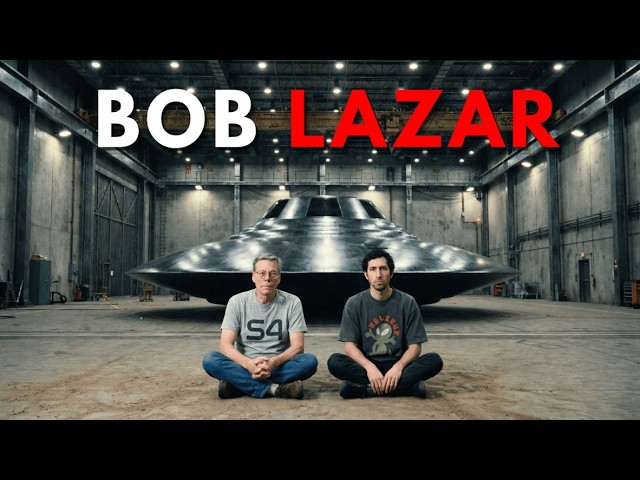
In 1989, Bob Lazar went public claiming he worked at a secret facility called S-4 near Area 51 in Nevada, where his job was reverse engineering the propulsion system of a non-human flying saucer. Nearly four decades later, he remains the only person to have claimed direct hands-on work on an exotic craft. This multi-day interview covers his childhood, how he got the job, new details about the craft and its retrieval, the beings that may have occupied it, his current home laboratory experiments, and never-before-seen UFO footage shown to him for the first time.
Bob’s Path to S4
Bob was a rebellious, science-obsessed child who took apart clocks and chemistry sets instead of playing with toys, had a problem with authority, and grew up moving frequently between the East Coast and California; his father had a wholesale food business with suspected mob connections tied to racehorses.
While working at Fairchild Electronics in Simi Valley, California, he built a jet engine from scratch and installed it in his wife’s Honda Civic, reaching speeds of 212 mph; he sent a resume to Los Alamos highlighting this project and got hired.
At Los Alamos in 1982, he worked on a half-mile-long linear particle accelerator, building high-voltage power supplies and maintaining targets and cryogenic equipment; he described the accelerator’s function as smashing particles apart and reconstructing their structure from the debris, like throwing a Swiss watch at a wall and figuring out how it works from the pieces.
He met Edward Teller, the hydrogen bomb’s creator, outside a lecture hall after arriving early and finding Teller reading the front page of the newspaper—which happened to feature the story about Bob’s jet car; Teller called the car “grossly impractical,” and they spoke briefly before the lecture began.
In 1988, after leaving Los Alamos, Bob sent Teller a resume referencing the jet car; Teller gave him a contact at EG&G, a government contractor known for nuclear test photography and instrumentation, which led to the S-4 job.
During the EG&G interview, they initially discussed one job but switched to a different position after Bob returned from the bathroom; he believes they were stuck on the S-4 problem and needed an outside-the-box thinker rather than another conventional physicist.
He was screened on his hobbies and personal projects rather than formal credentials; they were looking for someone unconventional who approached problems from unusual angles.
Arriving at S4 and the First Briefings
Bob was flown from McCarran Airport on a Janet government flight to Area 51, then driven on a blacked-out bus south to S-4 at Papoose Lake; the facility was built into a hillside with nine hangars and long cinder block corridors painted light and dark green.
His supervisor was Dennis Mariani, who shadowed him constantly; he was given a hand scanner and swipe card for access.
He reviewed briefings on three projects: Galileo (the propulsion system of the craft, his assignment), Looking Glass, and Sidekick (weapon potential of the craft’s gravity wave emitters for focused particle beams).
Galileo’s two primary directives were: (1) duplicate the propulsion system or components using available Earth materials, and (2) be able to remotely disable the system “at all costs.”
The briefings contained unique nonsense details—such as aliens making 65 corrections to human evolution—deliberately inserted so that if anyone leaked, the source could be identified by which false detail appeared.
He underwent medical screening including an allergen test and was given a deep orange-yellow vitamin B drink to boost his immune system, apparently because previous workers had severe reactions just from touching the craft.
The Craft and Its Anomalies
The craft Bob worked on, called the “sport model,” was approximately 53 feet in diameter with no seams, rivets, panels, buttons, wiring, or controls; it was made of a pewter-colored stainless-looking material that appeared different up close versus far away—close up it looked real, far away it looked cartoonish.
A unique structural anomaly: the main floor of the 53-foot disc has no central supporting column, which should be impossible with any known Earth material given the span and floor thickness; Luigi Vendetelli confirmed this through careful analysis of the access hatches and floor lip.
The craft has a black ring around the top section containing small square/rectangular holes that appear “blacker than black”—not Vantablack, but looking like bottomless pits; these are believed to be sensor arrays that determine position by reading starlight.
Inside, the craft is mostly unusable space; you must crawl to reach the center; there are three hump-like structures called “seats” that are actually amplifiers working with the reactor to generate and channel gravity waves to the emitters on the bottom.
One archway becomes transparent during operation, possibly for navigation; Bob saw three-dimensional symbols appearing in the air, not on a screen, resembling Korean-like characters.
Nine craft were stored in the hangars, all made of the same material but different shapes—like different vehicle models sharing the same engine; one was shaped like a Bundt cake (“Jell-O mold”), another like a top hat with a hole in its brim that looked like it was shot by a projectile.
Bob believes the sport model was retrieved by the Navy from an underwater archaeological dig; he theorizes the Navy gained control of the entire program through this retrieval, and notes that multiple sources describe deep ocean hotspots where craft are found.
The Reactor and the Force
The reactor sits on a hemisphere atop a 15-inch square plate; when activated with the emitter in the correct position, it produces a gravitational-type field that repels all matter without polarity—like pushing two like poles of a magnet together but with any matter, and the force is logarithmic (easy to push at first, then impossibly hard).
The reactor does not transfer force to its base when pushed—it pushes your hand away without sliding, meaning the force doesn’t couple to the reactor’s physical structure.
Barry Castilio, Bob’s lab partner, demonstrated the reactor’s effects: (1) a candle flame at the focal point stopped flickering and stood frozen in space and time while still visibly glowing, (2) rotating the emitter produced a small black ball in the air where no light escaped, like a tiny black hole, and (3) a mechanical watch placed in the field stopped completely.
Bob does not believe this is gravity; he thinks it is a completely unique fifth force because gravity is only attractive, only a property of matter, and would produce different effects on light and surrounding objects than what was observed.
The reactor’s power source is element 115 (moscovium), a superheavy element that did not exist on Earth at the time Bob described it in 1989; a cyclotron-like loop at the base of the reactor accelerates particles that interact with the 115 to produce the gravitational field.
Element 115 was synthesized in 2003 in Darmstadt, Germany, and turned out to be in group 15 of the periodic table—the same column as bismuth, which Bob kept hearing about at S4 and which shares the same valence electron structure.
A previous scientist working with the reactor was killed along with two or three others when they physically cut into a running reactor at the nuclear test site and it exploded; all prior research was lost, so Bob and Barry started from scratch.
The Test Flight and Witness Accounts
Bob witnessed a test flight of the craft from inside the hangar; a VHF radio was communicating with the craft, strongly suggesting someone was inside despite the cramped, unusable interior space.
The craft lifted off silently with a slight corona discharge glow, drifted into the sky, and moved around; when Bob walked underneath it, he could not see it at all—it was bending light around itself—and only caught the edge of it as he walked back.
The craft can operate in two configurations: Omicron (one amplifier, producing an unstable, wobbling, undulating movement) and Delta (all three amplifiers focused on a destination, locking the craft in space-time and enabling near-instantaneous travel by warping space rather than moving through it).
Bob brought Gene Huff and John Lear to a mesa near the Black Mailbox road outside Area 51 and showed them a test flight in March 1989; they were caught the last time and Bob was never allowed back.
John Lear was a brilliant but unfiltered pilot (son of Learjet inventor Bill Lear) who held wild beliefs (people living in the sun, the moon manufactured on Jupiter) but had genuine contacts and access; he connected Bob to George Knapp at KLAS.
George Knapp verified Bob’s Los Alamos employment by visiting the lab with Bob, where guards recognized Bob and he still knew combinations to secured areas; Knapp filmed everything and interviewed Bob’s former colleagues.
Going Public and the Aftermath
Bob decided to go public partly for self-protection—he was being followed, cars were parked outside his house, and he was starting to fear for his life—and partly out of frustration that the technology was being kept secret.
He first appeared anonymously (in silhouette as “Dennis”) on KLAS with George Knapp in May 1989; eight days later, on May 23, 1989, the U.S. Department of the Interior modified official maps of the Nevada Test Site, specifically removing the road leading to the east side of Papoose Lake where S-4 is located while keeping the western road.
After going public, Bob’s car doors were repeatedly found unlocked and open despite being tested and locked; his gun was found unsecured in his own vehicle; he and his associates checked the car for bombs before starting it.
He met Dennis Mariani at a casino through Gene Huff; Dennis never looked at him or spoke, and when Bob returned home, items had been taken from his house; Gene Huff noted that if Bob had invented the story, he randomly picked a stranger who played along perfectly.
Bob believes the program has moved out of Area 51 entirely, possibly to a remote location like Kwajalein Island in the South Pacific, to get farther from public eyes.
He has suffered significant health consequences from the stress of disclosure: five heart attacks (with clear arteries, all stress-induced), shingles across his face that nearly blinded him, and chronic anxiety.
Connections to Conventional Anti-Gravity Research
Dr. Charles Buehler, lead electrostatic scientist at NASA’s Kennedy Space Center and incoming president of the American Electrostatics Society, has been conducting anti-gravity experiments since 2016, producing measurable thrust (up to 50 millinewtons) using only electricity as input in hard vacuum (10⁻⁶ to 10⁻⁷ torr), ruling out ion wind as the cause.
Buehler’s thrusters operate at only 400 volts—far below the 150,000 volts used by Thomas Townsend Brown, the mid-century inventor who discovered that high-voltage asymmetric capacitors produce thrust; Buehler believes voltage is a proxy for electric field strength and has found ways to amplify the field at lower voltages.
Brown spent his career searching for high-K (dielectric constant) materials to amplify his effect; bismuth is one such material, and an isotope of bismuth was claimed in an interview to repel rather than attract gravity.
Bismuth is the most diamagnetic stable element on Earth—it pushes away from magnetic fields rather than being attracted—due to relativistic spin-orbit coupling in its superheavy electrons; it is also a natural topological dopant, inducing quantum states protected by the geometry of the material itself.
Element 115 (moscovium) shares the same five valence electrons as bismuth and sits in the same column of the periodic table, meaning it would have dramatically stronger relativistic effects and could theoretically be an even more powerful topological dopit.
Dr. Ning Li, a physicist at the University of Alabama-Huntsville who later worked at Redstone Arsenal, theorized that in superconductors, electrons could align into a coherent state producing a directional gravito-magnetic effect—structurally almost identical to what Bob described at S4 with the three emitters producing a directed gravitational field.
Bob believes the craft’s hull material is an electret (permanently storing an electric field, the electrical equivalent of a permanent magnet); bismuth titanate and bismuth ferrite are among the finest electret materials known, and bismuth ferrite is simultaneously ferroelectric and magnetic, with the two properties interacting.
Bismuth as the Connecting Thread
Bismuth appears repeatedly across UFO research and anti-gravity experiments: in Bob’s S4 briefings, in Townsend Brown’s high-K capacitor work, in Ning Li’s gravito-magnetic theory, as an ideal hull material for the craft Bob described, and in UFO samples being analyzed at Stanford by Professor Gary Nolan.
A magnesium-bismuth sample at Stanford has anomalous isotope ratios not found naturally on Earth and was recovered alongside a mid-20th century UFO crash; similarly, a famous Ubatuba, Brazil beach sample from the 1950s-60s showed the same anomaly.
Bob believes bismuth is at the edge of where relativistic electron behavior begins to dominate, and element 115 would take this to an entirely new level; he thinks the key to the craft’s propulsion lies in this physics.
Bob’s Current Research and Legacy
Bob runs United Nuclear, a company that sells scientific equipment including radioactive sources to government agencies for training; he finds it ironic that the same government that views him as a potential liability still does business with him, illustrating how disconnected government agencies are from each other.
He is currently conducting his own experiments in a home laboratory, attempting to duplicate the gravity-altering force he encountered at S4; he claims to have already gotten interesting results and is 100% confident he can duplicate at least some aspects of the craft’s propulsion.
He hopes to vindicate his experience through his own scientific work and believes the key insight is that the force is not gravity but a unique fifth force that can push or pull and affects the flow of time.
He does not seek attention and hates being on podcasts; he just wants to retire, read books, and work on his research in peace.
Luigi Vendetelli spent four years making the film “S-4: The Bob Lazar Story,” working closely with Bob to depict exactly what he saw; the production nearly bankrupted his company and involved institutional attacks including debanking and legal demands for all communications with Bob.
The film’s depiction of the craft’s appearance—looking correct up close but cartoonish from a distance—accidentally replicated a property Bob described about the actual craft, suggesting the model captured something genuine.
New Footage and Corroborating Evidence
Logan Paul showed Bob footage taken by two college students in 1995 near the Black Mailbox outside Area 51, showing an orange-reddish disc wobbling in place extremely close to their car; the craft’s color, shape, and undulating movement exactly match Bob’s descriptions and Luigi’s film.
The orange-red color is consistent with ionized nitrogen in Earth’s atmosphere interacting with the strong field generated by the craft.
Luigi used Google Earth historical imagery to find unblurred satellite photos of S-4 showing vehicle tracks going in every direction, proving ongoing activity at the site; he also enhanced a high-quality aerial photograph taken by a pilot 17 miles from Papoose Lake, revealing the slanted rectangular doors of the S-4 hangars.
Multiple people who verified Bob’s presence at S4 were threatened and never went public; George Knapp confirmed receiving threats when he tried to corroborate the story in 1989.
The Bigger Picture
Bob described the S-4 program as operating like a cabal or mafia—disconnected from normal government oversight, using intimidation rather than legal channels, targeting his marriage and personal life, and employing blackmail techniques; he and Luigi believe organized crime methods of keeping secrets are directly relevant to how the UFO program operates.
Jeffrey Epstein’s New Mexico ranch was located near Los Alamos, and Epstein was obsessed with gravity, the Casimir effect, and exotic physics; his emails contain surprisingly sophisticated statements about time being a function of cesium atom vibrations, and he held gravity conferences, suggesting he was either a front for or connected to the same network controlling exotic science.
Bob believes the Roswell crash involved two separate debris fields—Mac Brazel’s ranch (scattered debris including memory metal/nitinol-like material) and a separate crash site about 2 miles away containing a pod with bodies, one of which had been partially eaten by animals; Jesse Marcel’s son confirmed playing with the memory metal on his kitchen table.
A 1949 contract between Battelle Memorial Institute and Wright Air Field involved titanium-nitinol alloys; nitinol then appeared in a Navy lab in the 1960s, suggesting a classified pipeline from crash retrieval to materials science.
Bob’s core message: the data is real, the craft are real, and there are great ideas undiscovered; breakthroughs are available to those who can remove one of truth’s protective layers.