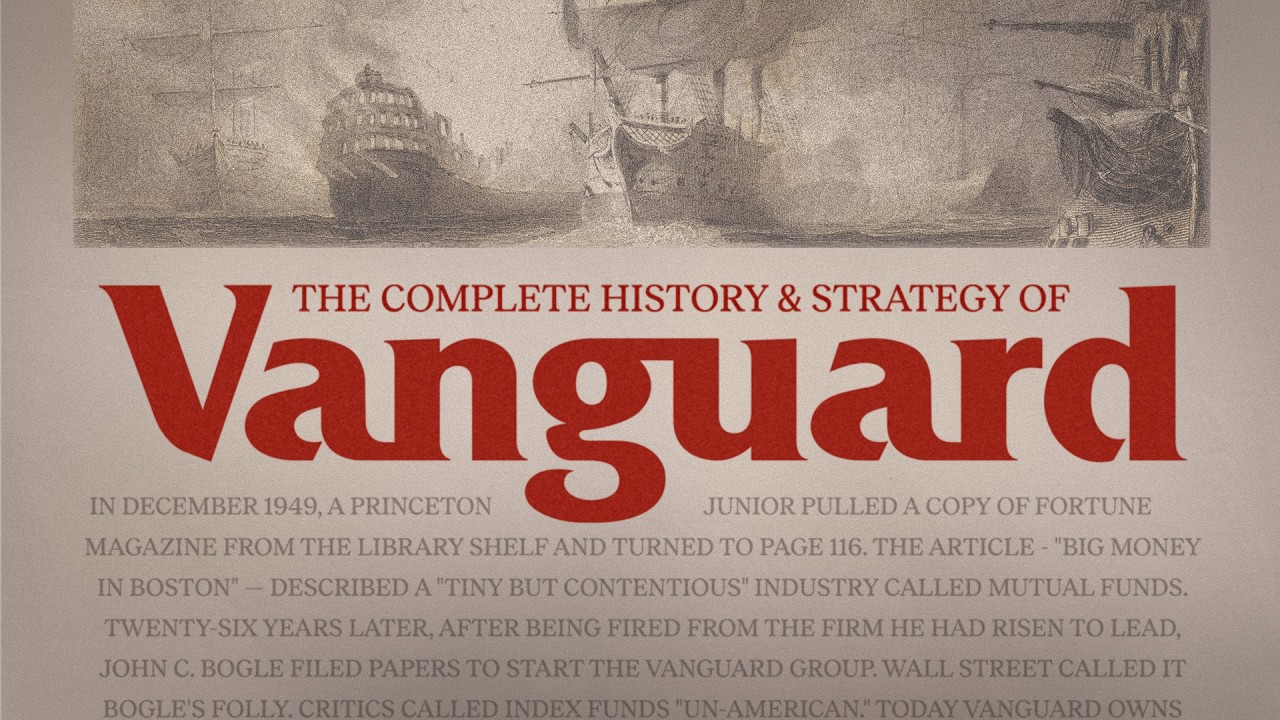
Vanguard is the company that created the first index fund for individual investors in 1975 and today manages over $12 trillion in assets, making it the largest provider of index funds in the world. It is owned exclusively by its fund investors—not outside shareholders—and operates at cost, returning all savings to customers through ultra-low fees. The man behind it all is Jack Bogle, who was fired from his previous firm, Wellington Management, and started Vanguard partly out of idealism and partly out of revenge. His insight was simple but revolutionary: in investing, the average investor can’t beat the market after fees, so the best strategy is to own the entire market at the lowest possible cost. Because of Vanguard’s relentless cost-cutting—and the competitive pressure it placed on the rest of the industry—investors have saved an estimated $1 trillion in fees that would otherwise have gone to Wall Street.
Jack Bogle’s Origins and the Seeds of a Revolution
Jack Bogle was born in May 1929, on the eve of the Great Depression, into a once-prosperous New Jersey family that lost everything. His father became an alcoholic, abandoned the family, and died alone; his mother suffered from severe depression. Jack and his two brothers essentially raised themselves, working multiple jobs from childhood. Despite this, Jack’s academic talent earned him a scholarship to Blair Academy and then Princeton, where he graduated magna cum laude.
At Princeton in 1949, Jack read a Fortune magazine article about mutual funds—a brand new industry—and wrote his senior thesis on it. The thesis, “The Economic Role of the Investment Company,” argued that fund fees were a drag on returns and that minimizing costs was the best way to maximize investor outcomes. He also noted the tautological insight that all investors collectively are the market, so before fees, the average investor earns the market return. After fees, the average investor underperforms.
Jack graduated in 1951 and was hired by Walter Morgan at Wellington Management in Philadelphia, a respected conservative mutual fund firm. Morgan became a father figure to Jack, and by 1965, at age 35, Jack was named president of Wellington. But the investing world was changing: the “go-go years” of the 1960s, led by Fidelity and its star manager Jerry Tsai, favored aggressive growth trading over Wellington’s conservative balanced approach.
The Go-Go Years, the Merger, and the Fall
To compete with Fidelity’s go-go style, Jack merged Wellington with a young Boston firm called Ivest, giving the four Ivest partners 40% equity in the management company. The merger was widely seen as Wellington overpaying for talent. For a few years it worked, but when the stock market crashed in the early 1970s—the oil crisis, stagflation, interest rates hitting 21%—the go-go strategy collapsed. The Ivest fund lost 65% in a year and was shuttered. Wellington’s assets fell from $2 billion to $480 million.
Jack had a crisis of conscience: his firm was still charging fees to clients whose capital was being incinerated. He proposed “mutualizing” the funds—having the funds acquire the management company, eliminating outside shareholders, and operating solely at cost for the benefit of fund holders. The idea was rejected by the Ivest partners and public shareholders of the management company.
Jack Gets Fired and Creates Vanguard
In January 1974, the Ivest partners and public shareholders voted to fire Jack as CEO of Wellington Management Company. But Jack was also chairman of the board of the funds themselves—a legal technicality that had always been a footnote. The funds had the contractual right to choose their own investment manager. Jack called a special meeting of the fund board and proposed they sever ties with Wellington Management and mutualize.
The fund board was skeptical but gave Jack a narrow mandate: he could form a new subsidiary to handle only fund administration (back-office work like accounting, tax, and legal)—not investment management or distribution. This was the least glamorous part of the business, and most firms outsourced it. Jack took the win. In September 1974, he incorporated the Vanguard Group, naming it after the HMS Vanguard, the flagship at the Battle of the Nile—a symbol of total victory over his former partners.
The First Index Fund
Jack was barred from offering investment advice, but he found a loophole: a fund that required no investment advice at all. The idea of an index fund—passively tracking the S&P 500—had been discussed in academic circles (notably by Nobel laureate Paul Samuelson in a 1974 paper) and attempted unsuccessfully by Wells Fargo for a pension fund. Jack realized that if Vanguard simply bought and held all 500 stocks in the S&P 500, no active management decision was needed, and the prohibition didn’t apply.
The math was compelling: the S&P 500 index (before fees) beat roughly half of active managers in any given year and 78% over a full decade. If Vanguard could offer the index at dramatically lower fees—approaching zero at scale—it would deliver top-tier performance. A 1% annual fee doesn’t sound like much, but over 40 years it consumes roughly 15% of your total returns. On a $100,000 investment at 7% annual returns, the difference between a 0% fee and a 1% fee over 40 years is about $500,000.
In 1976, Vanguard launched the First Index Investment Trust (later renamed the Vanguard 500 Index Fund, ticker VFIAX). The IPO was a disaster, raising only $11.3 million against a $150 million target—not enough to buy full 100-share lots of all 500 stocks, so they bought 280 stocks and sampled the rest. A part-time employee working nights and weekends at her husband’s furniture store in Delaware managed the portfolio. Fidelity’s Ned Johnson famously mocked the product: “I can’t believe the great mass of investors are going to be satisfied with just receiving average returns.”
The Machinery: Mutual Ownership and Scale Economies
Vanguard’s structure is its secret weapon: the funds own the management company, so the investors are the owners. There are no outside shareholders demanding profits. Any excess revenue is returned to investors through lower fees. This is “scale economies shared”—the same principle Costco uses, but taken further because Costco still has outside shareholders, while Vanguard has none. Every fee reduction is effectively a dividend to the customer-owners.
For the first decade, the index fund struggled. Assets barely grew, and in 1977 Vanguard had to merge a small legacy Wellington fund (the Exeter Fund, with $58 million) into the index fund just to keep it alive. The firm survived on fees from actively managed funds (notably the Windsor Fund, run by star manager John Neff) and its fixed income business, where low costs matter even more because bond returns are capped at coupon rates.
In 1981, Jack won the right to take over distribution by eliminating it—going “no load” and refusing to pay 8.5% sales commissions to brokers. This was framed as eliminating distribution rather than taking it over, another legal workaround. The fund finally reached $100 million in 1982 and $1 billion in 1988.
The Rise of Indexing and Jack’s Second Firing
By the 1990s, indexing was working. Vanguard’s model kicked into a harvesting phase: decades of sacrifice were paying off in accelerating growth. Assets reached $10 billion around 1992, and Vanguard launched the Total Stock Market Index Fund. By the mid-1990s, the two sister funds together approached $100 billion.
Jack had serious heart problems—a genetic condition that caused his first heart attack at age 31. In 1995, at age 66, he needed a heart transplant. He stepped down as CEO, handing the role to his former assistant John Brennan. Jack spent 128 days in the hospital waiting for a donor heart, running the company from his hospital room, and then made a miraculous recovery, living another 23 years.
Jack clashed with Brennan’s management team over new initiatives like sector funds, international expansion, and especially ETFs (exchange-traded funds). Jack hated ETFs because they trade on exchanges throughout the day, which he believed would encourage short-term speculation and undermine long-term investing. He turned down Nathan Most of the American Stock Exchange when Most came to Vanguard in 1992 with the ETF idea. Most went to State Street instead, which launched the first ETF (SPDR) and built a dominant position.
In 1999, Vanguard forced Jack off the board by enforcing a mandatory retirement age of 70. The move caused a public outcry—Jack had become “Saint Jack” to millions of investors, and a grassroots community called the Bogleheads had formed on Morningstar forums (later Bogleheads.org, now with 2 million monthly visitors). The compromise was that Jack would lead the Bogle Financial Markets Research Center on campus, evangelizing index investing for the next 20 years—the best marketing Vanguard could never buy.
The 2008 Financial Crisis: Vanguard’s Finest Hour
The financial crisis was the ultimate stress test of active management’s promise: that smart managers would protect investors in a downturn. They didn’t. Active funds, hedge funds, and alternatives were crushed just as badly as the index. Public sentiment turned sharply against Wall Street—bailouts, Occupy Wall Street, Lehman Brothers. Vanguard, with its no-profit, customer-owned structure, was perfectly positioned as the hero of Main Street.
Warren Buffett had made a famous bet in 2007: he wagered $1 million that the Vanguard 500 Index Fund would outperform a portfolio of hedge funds over 10 years. Only one person accepted: Ted Seides of Protégé Partners. The result was not close. The Vanguard fund returned 126% over the decade; the hedge fund portfolio returned just 36%. Seides conceded early. Buffett later wrote that if a statue were erected to honor the person who did the most for American investors, “the hands-down choice should be Jack Bogle.”
After the crisis, Vanguard’s market share of mutual fund flows doubled overnight, from 15 cents of every new dollar to 30 cents. In 2010, Vanguard passed Fidelity to become the world’s largest mutual fund manager. From 2014 to 2019, Vanguard took in $1.2 trillion in inflows versus $500 billion for the rest of the industry combined.
Fidelity and BlackRock’s Comeback
Fidelity’s strategy was to stop competing with Vanguard on funds and instead win on 401(k) plans and retail brokerage. Fidelity became the dominant provider of corporate 401(k) plans, and many Fidelity brokerage customers (including co-host Ben) hold Vanguard funds on Fidelity’s platform. This means Vanguard doesn’t have a direct relationship with many of its own fund holders. Fidelity also invested heavily in technology and customer service, exposing Vanguard’s weaknesses in those areas during the pandemic.
BlackRock’s comeback was built on ETFs. In 2009, during the financial crisis, BlackRock acquired iShares from Barclays for $13.5 billion. iShares became the dominant ETF platform, and today BlackRock has 1,400 ETFs with $3.3 trillion in assets—the largest in the market. BlackRock is also far more international than Vanguard and diversified into private assets, alternatives, and technology (its Aladdin platform).
Both Fidelity and BlackRock can afford to offer near-zero-fee index funds as loss leaders because they profit from other parts of the relationship—401(k) management, brokerage services, advisory fees. This raises the question of whether Vanguard’s pure no-profit model is now a competitive disadvantage.
Jack’s Death and the New Era
Jack Bogle died in January 2019 at age 89. At the time, Vanguard managed $5 trillion. His estate was worth roughly $80 million—a fraction of what the Johnson family (Fidelity, ~$40-50 billion) or Larry Fink (BlackRock, ~$1.5 billion) are worth. The difference—potentially $100 billion or more—went to investors in the form of lower fees. Morgan Housel’s framing: Jack was “an undercover philanthropist,” and at a trillion dollars of total wealth transferred to investors, the greatest philanthropist of all time.
In May 2024, Vanguard hired its first outside CEO in its 50-year history: Salim Ramji, formerly head of iShares at BlackRock. His mandate includes expanding the advisory business, improving technology and customer service, entering retirement services, and exploring private equity and crypto. Vanguard announced a partnership with Blackstone to offer private market access to retail investors—a dramatic expansion for a firm that once offered only S&P 500 index funds.
The Vanguard Effect and the Passive Investing Debate
Vanguard’s impact on the industry is called the “Vanguard effect.” When Vanguard launched its index fund in 1976, mutual funds charged 1.5-2% management fees plus 8.5% sales loads. Today, Vanguard’s average expense ratio is 0.07%, and the industry average is 0.44%—still 6.5 times higher, but dramatically lower than before. Vanguard’s competitors were forced to cut fees to retain customers.
Critics of passive investing raise several concerns:
Price discovery: If most money is passive, who sets prices? The counterargument is that prices are set by the marginal trader, and even a small amount of active trading is sufficient for price discovery.
Common ownership: Vanguard, BlackRock, State Street, and Fidelity together own roughly 24% of the U.S. stock market. If the same entities own every company, will those companies stop competing? This seems unlikely in practice, but the voting power of large index funds over corporate governance is a legitimate concern.
Systemic risk: If one of the giant index fund providers failed, the systemic fallout would be enormous—these firms are now “too big to fail” by any measure.
The S&P 500 index itself is not truly passive—it’s maintained by a committee of humans at S&P Global who decide which companies are included. But in practice, the S&P 500’s returns are nearly identical to the total market over long periods, so the distinction rarely matters for investors.
The Bigger Picture: Mutual Ownership and Why It’s Rare
Vanguard’s mutual ownership structure is extraordinarily rare at scale. A few other examples exist—REI, some insurance companies, some grocery co-ops, and Visa (which was originally a consortium of banks created by Dee Hock)—but none in asset management. The reason it’s so rare is that it requires a founder who is willing to forgo the wealth that would come from equity ownership. Jack Bogle’s own words: “I realized that a mutual company would never provide me with a personal fortune that so many denizens of Wall Street would earn, but it offered, I believe, my last best chance to resume my career.”
The structure works for asset management specifically because the product is capital—customers can provide the thing that investors would normally provide. It also works because asset management has enormous operating leverage: once the fixed costs are covered, managing $12 trillion isn’t much more expensive than managing $1 trillion. This is why a few index funds can theoretically scale to own everything.
Wellington Management, the firm Jack was fired from, went on to build its own $1.3 trillion active management business. In a delicious irony, Wellington still manages the original Wellington Fund within Vanguard to this day. Jack and the Ivest partners reconciled in the early 1990s.
By the Numbers Today
$12 trillion in total assets under management (as of 2025), with 84% in passive index funds and 16% in active strategies
50 million investors worldwide, though over 90% are in the U.S. (Vanguard is far less global than BlackRock)
Average expense ratio of 0.07% across funds; the VOO ETF charges 0.03%
20,000 employees
84% of Vanguard funds have outperformed their peers over the past 10 years
$1 trillion in total fees saved for investors across the industry since Vanguard’s founding—$500 billion directly from Vanguard’s low fees, and another $500 billion from competitors cutting fees in response