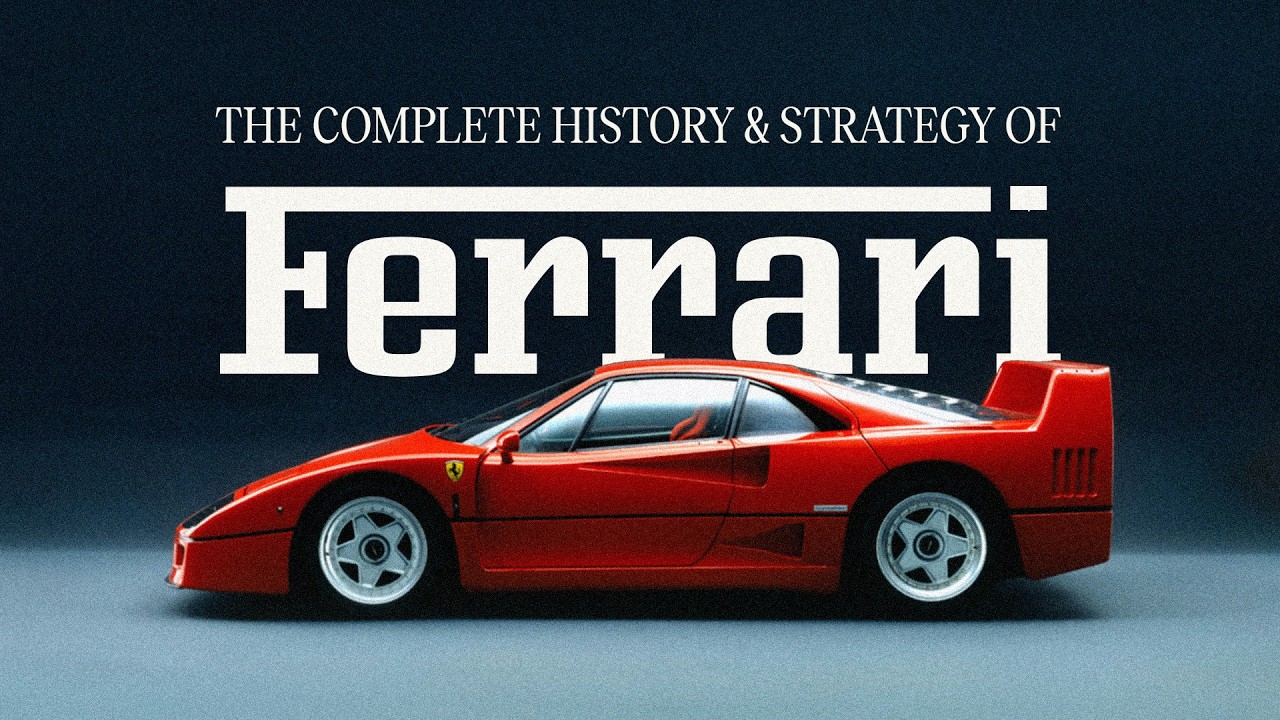
Ferrari is one of the most paradoxical companies in the world: it ships only ~14,000 cars a year (about 1/22nd of Porsche’s volume), yet has among the highest brand recognition on Earth—over a billion people know what a Ferrari is, giving it the highest ratio of brand awareness to actual ownership of any consumer company in history. It has the highest margins in the auto industry (~50% gross margin), a market cap that exceeds Ford, Volkswagen, Honda, Stellantis, and Mercedes-Benz, and about 80% of its new cars go to people who already own a Ferrari. The story of how this happened is one of the most dramatic in business: a half-century of death, speed, love, betrayal, and some of the most clever brand and business-model mechanics ever studied.
Enzo Ferrari: The Man Behind the Myth (1898–1947)
Enzo Ferrari was born in 1898 in Modena, Italy, the younger son of a middle-class metalworking shop owner. His father’s advice—“a company is perfect when the number of partners is odd and less than three”—stuck with him for life. His older brother Dino was the golden child; Enzo was the mischievous dreamer who wanted to be a racing driver.
World War I brought devastating tragedy: first his father died of pneumonia, then his brother Dino (who had enlisted) also died of pneumonia. Enzo himself contracted pneumonia in the army and nearly died. He later said, “I feel alone after a life crowded by so many events and almost guilty of having survived.”
After the war, he applied to Fiat and was rejected. He landed a job at a small automaker, pledged his future salary to buy a sports car, and began racing. He was talented but realized he lacked the one thing that separated champions from everyone else: he was too afraid to die. He had watched two mentor drivers die at the wheel, one literally in his arms.
In 1920, Enzo started a coachbuilding business in Modena that failed within two years. He became an Alfa Romeo dealer and, when Alfa Romeo cut back racing in 1925, proposed taking over their racing operations as a private, outsourced team—thus creating Scuderia Ferrari (“Ferrari Stables”). This was the first iteration of the Ferrari business.
Enzo always had a bigger ambition: to follow the path of the Maserati brothers across town and graduate from modifying other manufacturers’ cars to building and selling his own.
The Prancing Horse: Enzo adopted the black prancing horse emblem from the parents of Francesco Baracca, Italy’s top WWI fighter ace (who had painted it on his plane before being killed in combat). The countess told Enzo to paint it on his car for luck. Enzo placed it on a yellow shield (Modena’s city color) with the Italian flag above—a genius marketing move that linked the team to a national hero, framed racing as battle, and positioned Ferrari as Italy’s national racing team.
He also embraced Rosso Corsa (racing red), Italy’s assigned national racing color, and imbued it with passion, blood, and desire. Every other Italian supercar brand (Lamborghini) deliberately avoids red because Ferrari co-opted it completely.
Enzo was a natural-born entrepreneur and marketer—“Italy’s Steve Jobs.” He famously said he was “an agitator of men,” not an engineer or designer. The popular legend that he only cared about racing and wasn’t a real businessman is completely false.
In 1933, Alfa Romeo disbanded its factory racing team and designated Scuderia Ferrari as its official global racing operation. Enzo acquired the entire team—engineers, mechanics, everything. But then Hitler rose to power and German state-backed Mercedes and Auto Union dominated European racing. In 1938, Mussolini nationalized the operation. In 1939, Enzo was fired and his separation agreement forbade him from using the Ferrari name for four years.
During WWII, Enzo created “Auto Avio Costruzioni” (sneaking “auto” into the name) and made machine tools for the war effort, stamping each one with the prancing horse and “Scuderia Ferrari Modena.” In 1943, he moved operations 15 km south of Modena to Maranello to avoid Allied bombing—and Ferrari remains there to this day.
The Birth of the Ferrari Car Company (1947–1969)
After the war, Enzo was at a crossroads: rebuild the bombed factory and continue making machine tools, or return to cars. Luigi Chinetti—an Italian mechanic/racer who had spent the war in America—visited Enzo and described the enormous appetite of wealthy Americans for elite European machines. Enzo chose cars.
In 1947, the newly renamed Auto Costruzioni Ferrari built three racing cars, entered 14 races, and won 7. Enzo was 49 years old and had still never sold a car to a customer.
In 1948, they introduced the Ferrari 166 MM Barchetta at the Turin Motor Show—the first road car Enzo sold. Luca dal Monte described it as “a declaration of intent: a sports car with a sensual shape, as fast and powerful as it was beautiful and elegant.” About a dozen were made; two went to American clients through Chinetti.
The 1949 Le Mans victory: Against Enzo’s wishes, Chinetti entered a privately owned Ferrari 166 (owned by British nobleman Lord Selsdon) in the first post-war 24 Hours of Le Mans—and won. This was the first major international race victory for a Ferrari, achieved not by the factory team but by a private client. It perfectly illustrated the business model: the Ferrari name and myth created desire whether or not the factory team was involved.
Enzo’s famous quotes: “I sell engines and I throw the car in for free” and “Aerodynamics are for people who can’t build engines.” He was a deliberate late adopter of technology (resisting mid-engine layouts for years), partly to let others prove concepts first, but also because it built the Ferrari myth of doing things the traditional way.
The three-in-one model: Ferrari was revolutionary because it combined three things under one roof: a professional racing team, a world-class racing car constructor, and the full support infrastructure (tuning, maintenance, service) for both its own team and private clients. No other manufacturer did this. The same people making the F1 cars were building and servicing the road cars clients could buy.
Formula 1 began in 1950, and Ferrari was a founding team—the only one continuously operating from the sport’s inception to today. Buying a Ferrari road car gave clients a direct, ongoing connection to the pinnacle of motorsport that no other manufacturer offered.
Beauty, Tragedy, and the 250 Era (1950s–1960s)
The Ferrari 250 series (launched 1952) was the first real production Ferrari—a few thousand made over the decade. It included the 250 GT California (the Ferris Bueller car, though the movie used replicas, not real Ferraris). These cars were designed by Pininfarina, beginning a 61-year partnership (until 2013) in which Pininfarina designed nearly every roadgoing Ferrari. Enzo said he was looking for someone who could “convey in the shape of the body the power and philosophy of his cars.”
Italian vs. French luxury: French luxury (Hermès, LVMH) sells a dream of connection to royalty—refined, quiet, elegant. Italian luxury centers on craftsmanship, passion, and the designer’s personality. Italian luxury is about feeling something intensely; French luxury is about absorbing history.
The tragedies continued: In 1955, Alberto Ascari (son of one of Enzo’s deceased mentors, whom Enzo treated as a surrogate son) was killed practicing at Monza at the same age his father had died. Enzo vowed never to become emotionally close to a driver again.
In 1956, Enzo’s own son Dino (age 24), whom he had been grooming as his heir and kept away from racing, died of muscular dystrophy. This shattered Enzo—not only the grief of losing his son, but the end of his family line and the inherited company. He stopped attending races as self-inflicted punishment.
Enzo had an affair with a woman named Lina Lardi that produced a son, Pierro. But divorce was illegal in Italy and illegitimate children were legally invisible. Pierro could never publicly be a Ferrari or inherit the company.
In 1957, at the Mille Miglia (a legendary 1,000-mile Italian road race that had at least one death in almost every running), a Ferrari flew into the crowd, killing the driver and nine spectators including five children. Enzo was charged with manslaughter. The Vatican’s newspaper called him “an industrial Saturn” who “continues to devour his sons.” He was eventually acquitted and reached a compromise with the Vatican.
Paradoxically, all this tragedy was great for business. The deaths, the Vatican’s condemnation, the forbidden-fruit appeal—it only made Ferraris more romantic and coveted. As Enzo said, “One drives at high speeds in order to transcend oneself.”
By the early 1960s, Ferrari was producing 500 cars a year, split roughly equally between Italian, American, and European clients. Enzo published his memoirs titled My Terrible Joys. When asked what would happen to Ferrari when he was gone, he quoted Louis XV: “Après moi, le chaos.”
Ford vs. Ferrari (1963–1967)
In 1963, Henry Ford II (grandson of Henry Ford, looking to make his mark) sought to buy Ferrari. Negotiations proceeded to a draft agreement that would have created two companies: “Ford Ferrari” (90% Ford-owned, road cars) and “Ferrari Ford” (90% Ferrari-owned, racing). But Enzo discovered that Ford would have final authority over racing budgets—the one thing he would never surrender. He blew up the deal at the last moment.
The whole saga was reported in Italian papers as Americans trying to buy a national treasure, which was enormously good for Ferrari’s brand. Enzo’s opinion of Americans: “Treat an American like a hick and you’ll own him for life.”
Henry Ford II, incensed, told his lieutenants: “We will go to Le Mans and beat his ass.” Ford enlisted Carroll Shelby and driver Ken Miles, and after years of development, Ford beat Ferrari at Le Mans in 1966, finishing 1–2–3.
But the Ford saga was a sideshow. Enzo’s true intention was to signal that he was open to selling—but only on his terms, to the right partner, with racing control retained.
The Fiat Deal and Enzo’s Later Years (1969–1988)
In 1969, Enzo contracted serious kidney disease and believed he was dying. He struck a deal with Gianni Agnelli (patriarch of the Fiat family, who had been one of the very first Ferrari customers in 1948—a remarkable full-circle moment): Fiat would buy 50% of Ferrari immediately, with a secret agreement that upon Enzo’s death, Fiat would acquire another 40% (taking them to 90%) and 10% would go to Pierro.
The price: ~$3.5 million for 50%, valuing all of Ferrari at only $6.8 million. Enzo essentially had one bidder and needed the deal to keep Ferrari in Italian hands. Fiat also agreed that Enzo would retain final authority over racing for the rest of his life.
Enzo didn’t die. He lived another 19 years, until 1988. During that time, Pierro was able to work at Ferrari and eventually take the Ferrari name. The world changed enough that Pierro could become a legitimate heir.
The interregnum period (roughly 1970–1991) was mostly bleak for Ferrari. Fiat’s approach was to increase production and cut costs—sharing parts with Fiat cars, losing the connection between race machines and road cars. Production ballooned from 2,200 cars in 1982 to 4,500 in 1991. Demand evaporated; for the first time in history, cars went unsold and the factory had to be shut down.
Enzo’s last act was the F40 (1987), launched for Ferrari’s 40th anniversary. It was the rawest, most extreme supercar imaginable—door handles were pieces of string, the interior was bare carbon fiber, it was essentially a race car for the road. It was dangerous, impractical, and glorious. Enzo died in 1988 at age 90, and Ferrari won the very next F1 race (the Italian Grand Prix at Monza)—the only race they won that season.
Luca di Montezemolo’s Rescue (1970s and 1991–2014)
First act (1970s): Luca di Montezemolo was born in 1947 in Bologna and grew up close to the Agnelli family. In 1971, as a young rally car driver, he appeared on an Italian call-in radio show and gave a passionate defense of motor racing against a hostile caller. Enzo was listening, called the station, and said, “This boy has big balls. I want to talk to him.”
Enzo hired Luca as his assistant/spy to report on what was really happening in the company. When Fiat took over road car operations, Enzo assigned Luca to fix the struggling F1 team (which hadn’t won a championship in 10 years). Luca, not yet 30, became team manager, brought in aerodynamic expertise (shifting focus from engines to chassis), and recruited Niki Lauda. In 1975, Lauda won the drivers’ championship and Ferrari won the constructors’ championship.
But Enzo grew jealous of Luca’s success and their relationship became strained. Luca left to work for Fiat in 1976, remaining on Ferrari’s board but stepping away from day-to-day operations.
Second act (1991–2014): After the Fiat interregnum nearly destroyed Ferrari, Gianni Agnelli called Luca back: “We are putting Ferrari in your hands.” Luca returned as chairman (the most powerful title in Italian corporate governance; the CEO reports to the chairman).
His first test: he bought a Ferrari 348 (the flagship at the time) and found it was “the worst car we ever made. Everything was missing.” He drag-raced it against Volkswagen Golfs at stoplights and lost.
Ferrari conducted its own “Pepsi Challenge”: test drivers drove a Honda NSX and the Ferrari 348 around the track. The NSX blew the Ferrari away. If Honda could make a better sports car than Ferrari, the brand was in existential danger.
Luca’s three priorities: Team, Technology, Myth:
Team: He recruited the dream F1 team—Jean Todt (team principal), Ross Brawn (race engineer), and Michael Schumacher (driver). After a couple years of rebuilding, Ferrari unleashed absolute domination: five straight years (2000–2004) of both drivers’ and constructors’ championships. In total under Montezemolo, Ferrari won 19 drivers’ and constructors’ championships—more than under Enzo.
Technology: Enzo had been a late adopter; Luca made Ferrari a bleeding-edge innovator. R&D spending as a percentage of revenue became among the highest in the auto industry. The 355 (replacing the 358) was the workhorse of the turnaround—user-friendly, $127,000, accounting for 70% of sales by 1997.
Myth: This was Luca’s most important contribution. He understood that Ferrari is a luxury company, not just a racing company that sells cars. He instituted weightless, presentation ceremonies for car delivery, custom luxury leather luggage fitted to each Ferrari, and the full luxury playbook. He studied what Jean-Louis Dumas was doing at Hermès and applied it to Ferrari.
Manufacturing revolution: Luca redesigned the factories (bringing in trees, great architects) and transformed the production process. After 1994, Ferrari held zero inventory—every car was built only after a customer ordered and customized it. Every Ferrari that rolls off the line is unique. The factory is vertically integrated to an extreme degree: raw aluminum ingots arrive on trucks, and Ferrari casts its own engines in an on-site foundry. Everything happens on one plot of land in Maranello. No Ferrari shares a platform with any other car (unlike Lamborghini Urus = Porsche Cayenne = Volkswagen Touareg).
This is inefficient but gives Ferrari maximum flexibility. They can change engine casting specs without involving suppliers, and they can get learnings from the F1 team (right across the street) into road cars quickly. They can launch four new models per year and discontinue them after 4–5 years—something no other manufacturer can do because they lack the flexible, low-overhead manufacturing process.
Production discipline: When Luca returned in 1991, production was 4,500 cars. He cut it to 2,300 within two years. It didn’t surpass the 1991 peak until 2006—15 years later. Today Ferrari ships ~14,000 cars a year and caps its SUV (the Purosangue/FUV) at 20% of total volume.
Maserati strategy: Fiat placed Maserati under Ferrari’s management, creating a “Rolex and Tudor” dynamic—a more accessible brand for clients who wanted a four-door or a daily driver, without diluting Ferrari itself.
Brand licensing: In the financial crisis years, Ferrari licensed the brand widely for merchandise (generating nearly 100% margin). This included some low points (an Acer netbook in 2009), but the strategy was justified by Ferrari’s unique position as both an apex luxury brand and a mass-appeal sports team with hundreds of millions of fans (the “tifosi”) who need affordable ways to participate in the brand.
The IPO and Sergio Marchionne (2003–2018)
Gianni Agnelli died in 2003; his brother Umberto died a year later. The Agnelli empire was in crisis, and Fiat was struggling with falling sales and massive debt. Susanna Agnelli (Gianni’s sister) asked Luca to become chairman of Fiat in addition to Ferrari, to serve as a steward for the next generation (John Elkann, then 27).
Luca, John Elkann, and Sergio Marchionne (a turnaround expert brought in as Fiat CEO) miraculously saved Fiat. They launched the smash-hit Fiat 500 (1 million units in five years), restructured operations, extracted Fiat from a disastrous GM partnership (GM paid $2 billion to end it), and then acquired Chrysler essentially for free during the 2008 financial crisis, creating FCA (Fiat Chrysler Automobiles).
But assuming Chrysler’s debt ballooned FCA’s total debt to over $11 billion. Marchionne promised Wall Street he’d reduce it to $1 billion or less by 2018.
The conflict: Luca and Marchionne were both brilliant but cut from different cloth. Luca was a car guy who believed great business decisions flow from great car decisions. Marchionne was a financial engineer and empire builder. They needed cash to pay down the Chrysler debt, and Marchionne’s solution was to IPO Ferrari.
Luca was deeply opposed. Going public means delivering consistent, predictable growth on a Wall Street calendar—shipping more cars, adding more models, raising prices mechanically. It’s anathema to the organic, long-term luxury strategy Luca had built.
In September 2014, Marchionne fired Luca as chairman, using the pretext of poor F1 performance (which was partly due to Fiat never having developed hybrid technology). Bernie Eccleston, Luca’s longtime adversary in F1, paid tribute: “Luca leaving is for me the same as Mr. Enzo dying. He has become Ferrari.”
The IPO (2015): FCA floated 10% of its 90% stake on the New York Stock Exchange (ticker: RACE) at a $9.8 billion market cap, raising ~$1 billion. As part of the spin-off, FCA also transferred $3.2 billion in debt to Ferrari—so the total debt reduction for FCA was ~$4 billion. Ferrari was more than capable of handling it.
The value unlock was unprecedented: within a few years, Ferrari’s market cap reached ~$90 billion (recently ~$55 billion after a correction), far exceeding Stellantis’s market cap. Ferrari was not appreciated as the gem it was when buried inside Fiat.
Sergio Marchionne died suddenly in 2018 from cardiac arrest following shoulder surgery complications—a shocking tragedy that echoed the pattern of those closest to Ferrari being struck by fate.
Ferrari Today: The Business and the Cars
Current CEO: Benedetto Vigna (since 2021), a former semiconductor physicist who holds patents for the accelerometer in the original iPhone—a tech outsider, which signals Ferrari’s direction.
Model range: Ferrari has roughly quadrupled its model range since the IPO:
Range (~85% of units): Core sports cars and GTs—Amalfi, Roma, Tributo, 12 Cilindri. Base prices ~$280K–$400K before customization.
Special Series (~10%): Higher-performance, more limited versions of range cars (the “M series” or “AMG” equivalents). $500K–$1M.
Icona Series (~a few percent): Homage models (Daytona SP3, Monza SP1/2) at ~$2.3M. These effectively smooth out the profit seasonality between supercar cycles.
Supercars/Halo cars (1–5% of units): F40, F50, Enzo, LaFerrari, now the F80 (~$4M each, 799 units). These are critically important to profits—the F80 alone may contribute ~30% of Ferrari’s annual profits in its first year, despite being only 15% of revenue.
One-offs: Truly custom cars with custom body styles for the most special VIP clients, never publicly disclosed.
The FUV (Purosangue): Ferrari’s answer to the SUV craze (60% of Porsche and Lamborghini sales are SUVs). Ferrari calls it an FUV (Ferrari Utility Vehicle) and named it “Purosangue” (pureblood/thoroughbred). It has a naturally aspirated V12 and production is capped at 20% of total volume—a disciplined sacrifice of short-term profits to protect the brand.
Customization: Every Ferrari is unique. Customization adds 20%–100% to the base price. The average selling price is ~$500,000 (up from $350,000 in 2022).
Dealers: Allocation is now controlled centrally by Ferrari. Dealers serve as franchised service and delivery infrastructure, but Ferrari owns the customer relationship. Dealers get 100% of secondary market transaction economics, incentivizing a thriving used market.
Ferrari Classiche: A $6,000–$10,000 certification program where Ferrari inspects and blesses used cars as genuine. This creates a closed ecosystem of meticulous maintenance records and appreciating assets. Over 90% of all Ferraris ever made are still on the road.
The Ferrari Pyramid: Ferrari has built an elaborate ecosystem—ever-more-rare models, clubs, track days, factory tours, racing programs, Classiche certification, fashion, theme parks (Spain and Abu Dhabi)—so that every fan and owner always has somewhere to “graduate” to. This infrastructure is expensive to operate but essential for a brand that the whole world lusts after.
The most extreme clients can buy a former F1 car. Ferrari stores it in Maranello with a full engineering and mechanics team, and clients can come race it on Ferrari’s private test track (built in 1972 adjacent to Enzo’s farmhouse).
Key numbers (2025):
13,640 cars delivered (330,000 ever made; Porsche delivers more in a year than Ferrari has ever made)
~81% of new Ferraris sold to existing clients; 48% to clients adding to existing collections
~50% gross margin (vs. Ford 7%, BMW 14%, Porsche 15–25%, Hermès 71%)
~$170,000 gross profit per car (Porsche needs to sell 6 cars to equal one Ferrari’s profit)
Revenue segments: 84% cars/spare parts, 11–12% sponsorship/commercial/brand (F1 is now a profit center, not just marketing spend), 4.5% financial services and engine sales to other F1 teams
Trades at ~35x price-to-earnings (down from ~50x pre-luxury slump; most automakers trade at 8–10x)
Management has guided to 5% annual revenue growth for the next five years, signaling the end of double-digit growth
China: Only 7% of Ferrari’s sales (down from 10% peak), vs. Porsche’s 33% (now collapsed to 15%). Ferrari’s brand heritage and myth make it more resilient to the domestic EV onslaught, but it’s a risk to monitor.
The Luchè: Ferrari’s Electric Future
In 2026, Ferrari will unveil the Luchè, its first electric vehicle, designed in collaboration with Jony Ive and Mark Newson at Lovefrom in San Francisco. They unveiled only the interior components (buttons, dials, steering wheel) at the top of the Transamerica Pyramid—a deliberate appeal to a different, design-conscious demographic.
It features quad motors (one per wheel) plus additional motors for independent steering and suspension, creating illusions of lightness and balance in a heavy battery-powered car.
The bull case: Ferrari is creating a new pyramid for a new audience (tech-forward, design-obsessed buyers who would never buy a combustion Ferrari) while protecting the existing pyramid. The bear case: electric supercars have zero inherent demand (a Tesla Model S Plaid does 0–60 in 1.99 seconds vs. the F80’s 2.2), and speed is no longer a differentiator.
But abdicating the EV future to Chinese brands would be a strategic mistake. Ferrari is taking its own swing.
Analysis
Seven Powers:
Brand: The strongest power, though Ferrari’s brand is more product-dependent than Hermès or Patek Philippe—a Ferrari has to be a genuinely exceptional car, not just a badge. Still, the Ferrari premium over Lamborghini (the closest competitor) is ~50% on average selling price and growing.
Scale economies (Goldilocks): Ferrari is big enough to support massive infrastructure (F1 team, factory, community programs, R&D) but small enough to maintain flexibility and exclusivity. Pagani is too small; Toyota is too big. Ferrari is “just right.”
Network economies: The tifosi community—hundreds of millions of fans, car meetups, track days—creates a self-reinforcing ecosystem. It’s a way for people (especially adult males) to make friends and belong. The community is open and welcoming, which paradoxically strengthens the exclusive brand.
Cornered resource: Enzo, the history, the myth, the unbroken F1 heritage since 1950. Ferrari also owns its own test track.
Counterpositioning, switching costs, process power: Minimal or none.
Why imitators fail: No other brand has maintained the continuity of the Ferrari myth for 80 years. Lamborghini lacks racing heritage. Aston Martin has been poorly managed. McLaren has had ownership instability. The Ferrari playbook requires unbroken heritage, product excellence, and patience that no competitor has sustained.
Quintessence: Ferrari is the marriage of a luxury brand and a sports team—simultaneously exclusive and inclusive. It has the scarcity and pricing power of Hermès with the mass cultural passion of Manchester United. This combination is a business cheat code that no other company has replicated.