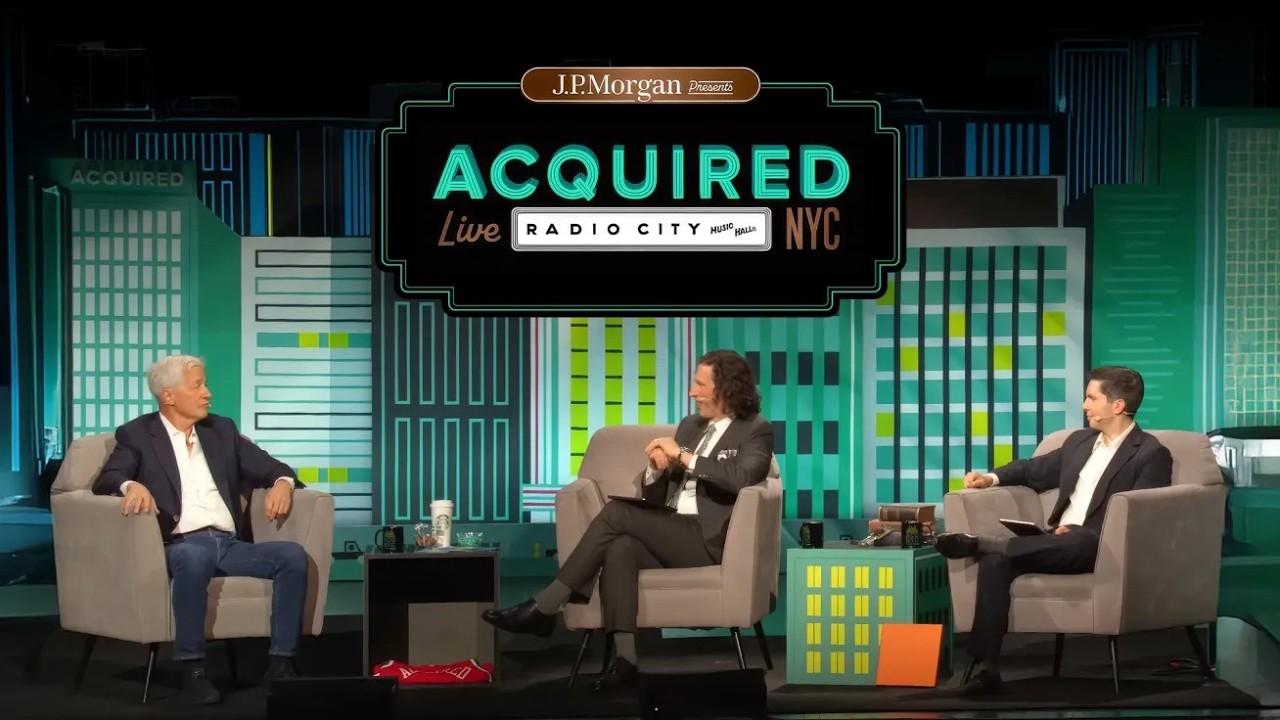
- Acquired hosts a landmark live show at Radio City Music Hall in New York City, featuring three conversations with iconic New York company CEOs — Jamie Dimon (JPMorgan Chase), Meredith Kopit Levien (The New York Times Company), and Barry Diller (IAC) — in front of a sold-out audience, marking a major milestone for the podcast a decade after its founding.
Jamie Dimon on Building JPMorgan Chase into the World’s Most Important Bank
-
The Citi ouster and restart: In 1998, Jamie Dimon was fired as president and COO of Citigroup, where he had spent 13 years building the modern financial conglomerate alongside mentor Sandy Weill. Despite being the expected successor, he was forced out in a boardroom coup. He described going home to tell his children — one of whom asked if they’d have to sleep on the streets, another if she could still go to college, and the oldest if she could have his cell phone.
- He spent the next 18 months exploring options, including a call from Jeff Bezos about running Amazon, before taking the CEO role at Bank One, a troubled $30 billion market cap bank based in Chicago — a steep downgrade from Citigroup’s $200 billion.
- He invested $50 million of his own money (half his net worth) in Bank One stock on day one, an almost unprecedented move that signaled total commitment to employees and shareholders.
-
Fixing Bank One: Bank One was a mess of merged entities (First Chicago, National Bank of Detroit) that had never been integrated — multiple systems, competing brands, 21 board members who hated each other, and aggressive accounting that masked massive credit losses. Dimon went through every loan on the books, marked them down, built reserves, and hired Linda Bammel to aggressively hedge credit risk, reducing the balance sheet by $50 billion.
-
The “Fortress Balance Sheet” philosophy: Dimon’s core operating principle is planning for the worst-case scenario, not the base case. He stress-tests against “fat tails” — market down 50%, rates to 8%, credit spreads to worst-ever levels — rather than the Fed’s milder scenarios. This meant JPMorgan earned lower returns than peers in good years (never the 30% ROE that bankrupted others) but survived crises intact. He attributes this to growing up watching his father live through the 1972–74 crash (-45%), the 1982 recession, the 1987 single-day -25% crash, and the early-1990s real estate crisis.
-
The 2004 JPMorgan merger: Dimon had long seen JPMorgan as a logical merger partner. After four years of fixing Bank One, the stock had doubled, bringing it into range. The deal was structured as a “merger of equals” with Bank One shareholders getting 42% of the combined company, but the agreement effectively gave Dimon control from day one — 75% of the board would have to vote him out within 18 months for him not to become CEO. Shareholders sued both sides, claiming the price was too high and too low simultaneously.
-
2006–2008: Pulling back while others charged: In 2006, Dimon saw cracks in subprime and pulled back, though he wishes he’d done more. He stockpiled liquidity, maintained lower leverage than competitors (who went from 12x to 35x leverage under Basel I accounting rules), and eliminated side deals and profit pools that incentivized excessive risk-taking by senior bankers. He changed compensation structures so no one was paid on a single deal’s profits.
-
The Bear Stearns rescue (March 2008): On his birthday, Dimon got a call from Bear Stearns CEO Alan Schwartz asking for $30 billion before Asia opened. The Fed couldn’t lend directly, so they structured a one-day loan through JPMorgan using Bear’s collateral. Over a weekend, thousands of employees did full due diligence on every loan, asset, derivative, and lawsuit. JPMorgan bought Bear for $2/share (down from $150), a $1 billion price for a company recently worth $20 billion. Dimon estimates the total cost at $12–20 billion including write-offs and a $5 billion government settlement over Bear’s bad mortgages — a settlement he found offensive since JPMorgan had helped save the system. He famously told Attorney General Eric Holder: “I am here to surrender. I cannot fight and cannot win against the federal government.”
-
The WaMU acquisition: A week after Lehman’s bankruptcy, JPMorgan bought Washington Mutual for a $30 billion discount to tangible book value, effectively getting a clean bank with 2,300 branches in California, Florida, Georgia, and other healthy states. Dimon then raised $11 billion in new equity within days — capital he didn’t strictly need — to ensure the balance sheet was stronger after the acquisition than before. The integration was completed in nine months.
-
2023: Silicon Valley Bank and First Republic: Both banks failed due to concentrated deposits (VCs telling portfolio companies to withdraw) combined with interest rate exposure hidden by “held to maturity” accounting. Dimon had warned Treasury Secretary Yellen about First Republic and offered to buy it. JPMorgan acquired it, hedged all exposures within days, and wrote everything down. From First Republic, they adopted the high-net-wealth client service model — single point of contact, concierge-level banking — and are now rolling out “JPMorgan Financial Centers” on Madison Avenue and beyond, their first branded consumer banking effort.
-
Why JPMorgan pulls away from the pack: Dimon describes the strategy as a portfolio of businesses that feed each other — consumer, credit card, investment banking, wealth management, corporate banking — with no “hobbies” or extraneous businesses. The efficiency ratio advantage (keeping ~15 more cents of every dollar than competitors) comes from continuously investing in people, branches, and technology while gaining business at the margin. He compares it to sports: a team of jerks never wins, and practice matters — Tom Brady worked hard every day.
-
Why he’s still here: Dimon, now in his 60s, traces his work ethic to his Greek immigrant grandparents and their ethic of purpose, giving your all, and treating everyone properly. His hierarchy: family first, country second (“the indispensable nation” with freedom of speech, religion, and enterprise), and his purpose through JPMorgan — helping cities, states, schools, companies, and employees. He has no interest in retiring (“I don’t play golf”) and when asked about the one job that could have more impact, he effectively said he’s already in it.
Meredith Kopit Levien on The New York Times Company’s Digital Transformation
-
From near-death to 12 million subscribers: When Acquired covered the Times in 2021, the company had about 5 million subscribers. It’s now closing in on 12 million, with revenue and profit at all-time highs and a market cap near $10 billion. Weekly, 50–100 million people visit Times websites and apps, 20 million listen to podcasts and read newsletters, and 150 million have registered.
-
The strategy: essential subscription for curious people: The Times aims to be the essential subscription for people who want to understand and engage with the world, built on three pillars: (1) the world’s best news destination, (2) market-leading lifestyle products (games, sports, shopping advice, recipes) that help people make the most of their passions, and (3) a connected bundle that makes the Times valuable regardless of what’s happening in your life.
-
Build and buy done right: Three acquisitions have worked because they fit the deliberate strategy — The Wirecutter (product reviews, driving ~$1 billion in commerce annually), The Athletic (550 journalists, the world’s largest sports newsroom, now the fastest-growing audience on the Times), and Wordle (acquired the same week as The Athletic for single-digit millions). Each sits in a giant market, leverages the Times’ ability to do something rare, and feeds the rest of the portfolio — someone coming to play a game is just as likely to read about the war in Ukraine as the reverse.
-
Print is still ~25% of the business: Despite the digital transformation, the physical newspaper remains a significant and durable revenue stream. The shift has been from playing defense (can we transform out of being a newspaper company?) to playing offense (what can journalism be and do in people’s lives?).
-
AI: force multiplier, not replacement: The Times firmly believes journalism is a human endeavor — you can send a drone to a war zone, but a human talking to people who’ve just been impacted is fundamentally different. AI is being used as a force multiplier: automated voice reading of articles for accessibility, journalists using AI to comb through troves of public documents, and making journalism more accessible. The optimism about AI is contingent on creators being fairly compensated — hence the lawsuit against OpenAI and Microsoft for training on Times content without permission.
-
The OpenAI lawsuit: The Times believes LLM makers spending hundreds of billions on compute and energy should also pay fair value for the content their models are built on. The lawsuit isn’t just about journalism — it’s about any creator or IP maker, which the Times sees as foundational to American competitiveness. The Times is simultaneously open to partnerships when terms are right, as demonstrated by a recent deal with Amazon that gave the Times control over how its content is used.
-
On accusations of anti-tech bias: Levien pushes back on the premise, noting that the Times covers tech companies broadly and seriously because of their power and influence — comparable to governments — in shaping the information ecosystem. The job is to pursue the truth wherever it leads, with enormous effort put into reducing bias through a giant standards operation, dual editing of every story, and verifiable sourcing.
-
Podcasts and trust-building: The Times’ podcast portfolio (The Daily, Ezra Klein Show, Interesting Times with Ross Deth, Hard Fork) deepens engagement with existing readers, brings in new audiences, and builds a different kind of relationship — listeners feel like the hosts are their running partners. When a reporter goes on The Daily, they’re not just summarizing a story; they’re exposing how the story came to be, which builds trust. The informal style has even spilled back into how text articles are written.
-
Live Wordle: Levien played a custom Acquired-themed Wordle on stage, eventually guessing “Lloyd” (referencing the founder of a predecessor to one of the world’s largest retailers) with heavy hints from the hosts.
Barry Diller on a Six-Decade Career Spanning Media and Tech
-
From the mail room to mogul: Diller started in 1961 at age 19 in the mail room at William Morris Agency, where he spent three years reading the entire file room from A to Z — 70 years of entertainment business history, including the complete correspondence of Elvis Presley and every major figure. He calls it the best possible foundation, equivalent to having the email archives of all Hollywood executives.
-
ABC: the startup inside a network: ABC was the youngest and least established of the three networks, which meant it operated like a startup — if you wanted responsibility, you could just take it. At 25½, Diller became the youngest VP ever and was put in charge of acquiring movies. He created the “Movie of the Week” — original movies made for television, which everyone thought would fail. Starting with one employee (himself), they scaled to making 75 original movies a year at ~$500,000 each, and he learned management by doing every task himself first.
-
Paramount: from near-failure to #1 studio: Gulf & Western’s Charles Bluhdorn made Diller chairman of Paramount in his 30s, over Diller’s own objections. The first two years were rough, but Saturday Night Fever (starring TV actor John Travolta, whom Hollywood snobs dismissed) and Grease turned things around, followed by Indiana Jones and Star Trek. The key innovation was bringing TV-style development to movies — maintaining 90 projects in various stages and curating them, rather than relying on agent-assembled packages.
-
Fox and Rupert Murdoch: Diller partnered with Murdoch to found Fox as a fourth TV network. He describes Murdoch as “one of the great entrepreneurial gamblers” who built media empires on four continents by betting the company repeatedly against the establishment. Murdoch gave Diller complete operating authority — they had one disagreement in eight years. Diller’s take: work for someone like Murdoch if you can, but never run a company that way yourself unless you have no other options.
-
The leap to independence: Despite being “fat and happy” at Fox, Diller felt a binary compulsion — either you’re capable of being independent or you’re not. He gave up the private plane and big organization to find out. His wife Diane von Fenberg discovered QVC, a home shopping network in Westchester, Pennsylvania, and insisted he visit. He was struck by the primitive interactivity — screens showing call volume rising and falling in real time as products were displayed — an epiphany that screens could be used for commerce, not just storytelling. He bought in during 1993, two years before the internet went mainstream, giving him a head start on understanding connectivity and e-commerce.
-
IAC’s portfolio: Diller’s IAC would go on to buy, sell, start, or spin off over 150 companies including Expedia, TripAdvisor, Angie’s List, Vimeo, Ticketmaster, Tinder, and Match.com.
-
Why tech now dominates media: For ~75 years, the movie business survived every technology disruption (VCRs, cable) by absorbing them. Netflix truly won and no one will beat them. Amazon and Apple, with a hundred times the resources of old studios, use content as a loss leader for other businesses (Prime subscriptions, device sales) rather than needing to create hits. Movie and TV production is just not big enough to matter to these companies — it’s a feature, not the product.
-
Advice to entrepreneurs: “Be curious.”
The Evening’s Arc
- The show was structured in two acts: Act One was the serious, in-depth conversation with Jamie Dimon about JPMorgan’s history and crisis leadership. Act Two was a lighter, late-night talk show format with Andrew Ross Sorkin moderating a trivia quiz, followed by conversations with Meredith Kopit Levien and Barry Diller, including the live Wordle game.
- The most-listened Acquired episode was revealed to be the Starbucks episode featuring Howard Schultz at 1.3 million downloads, narrowly edging out the Hermès and Rolex episodes.
- The evening closed with thanks to JPMorgan (title sponsor), Hermes (who dressed the hosts), and the hundreds of people who made the Radio City show possible — a surreal full-circle moment for a podcast that started 10 years ago as “a tech podcast.”