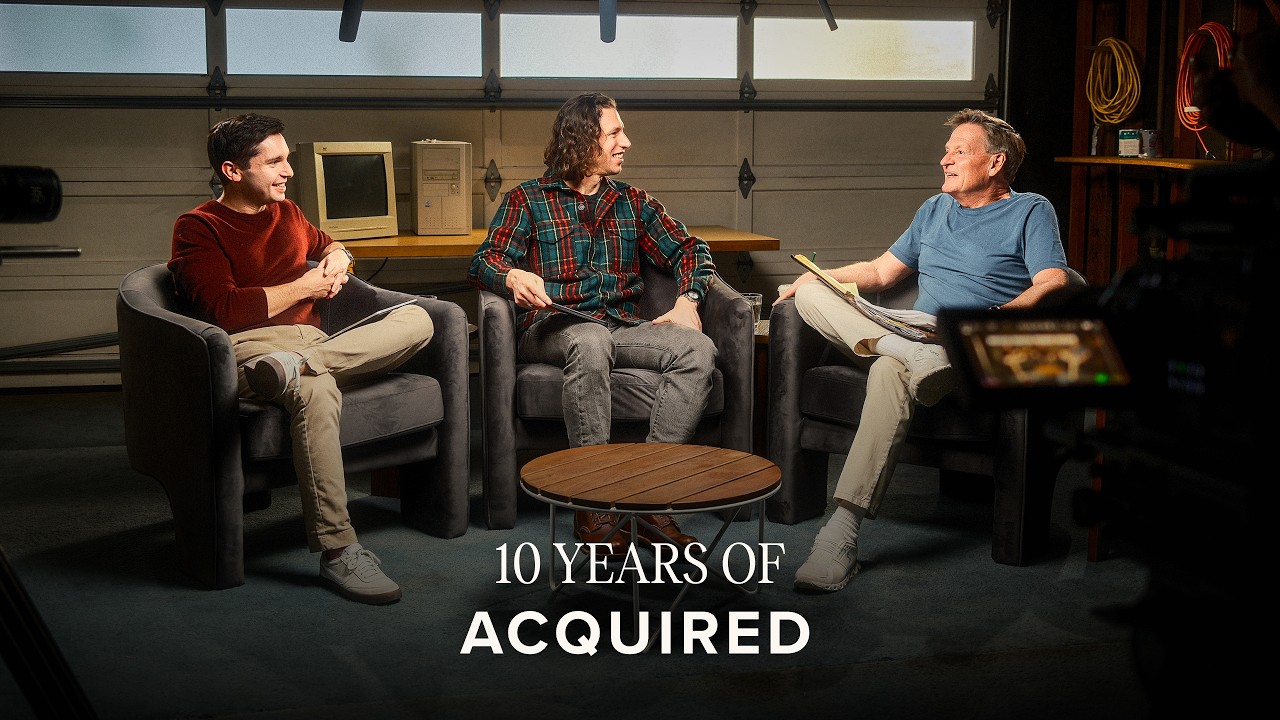
Acquired is a podcast about great technology companies and the stories behind them, hosted by Ben Gilbert and David Rosenthal, which turned 10 years old in 2025. To mark the occasion, they recorded a special episode in the literal garage where Google got its started, with guest Michael Lewis — author of Moneyball, Liar’s Poker, The Undoing Project, and host of Against the Rules — to unpack why a four-hour, infrequently released podcast has succeeded when 99% of podcasts do not.
The Partnership Is the Product
Ben and David met as colleagues at a venture capital firm, bonding over a shared obsession with Apple rumors, Stratechery (Ben Thompson’s tech strategy blog), and a mutual curiosity about how businesses work. Their relationship is the foundational asset of Acquired — they describe each other as a second spouse, sharing a bank account before either shared one with their actual partners.
They have been equal partners in Acquired since day one, even during the years when David was full-time on the podcast and Ben was still working in industry. Neither ever raised the issue of unequal ownership. They say the collaboration only works because there is zero status difference between them and no boundary where one person’s contribution ends and the other’s begins.
Michael Lewis compared their dynamic to the collaboration between psychologists Daniel Kahneman and Amos Tversky — a relationship so intense that their spouses were aware it was the most important relationship in their lives. Ben and David say theirs is non-competitive, with only two or three real moments of tension in 10 years.
Scarcity as Strategy (Lesson from the NFL and Hermès)
Acquired releases far fewer episodes than typical podcasts — 12 per year for the last three years, dropping to eight planned for 2026, each around 3.5 to 4 hours long. This is the opposite of standard podcasting advice, which emphasizes constant output.
They learned the principle of engineered scarcity from studying the NFL (which limits its product to make every game an event) and Hermès (which builds a luxury empire around the constraint that every Birkin bag is handmade by one artisan). They applied this by deciding every episode would be entirely handcrafted by the two of them — all research, all recording, all editing — and building a business model around that constraint.
They used to feel like they were “bad at podcasting” because they couldn’t produce at high volume and didn’t have a production team or professional ad sales. Once they admitted they were heavily constrained and leaned into it, they found they could build a large platform and a durable business.
The “Too Hard Pile” (Lesson from Berkshire Hathaway)
From Warren Buffett and Charlie Munger, they adopted the concept of the “too hard pile” — the disciplined practice of saying no to almost everything so you can focus on the rare things worth doing. Buffett and Munger famously put all technology into the “too hard” category for years.
For Acquired, the too hard pile includes Hollywood (they’ve had many opportunities to adapt content into TV or film but always concluded the opportunity cost was too high), the Federal Reserve (they researched it and walked away), and Bell Labs (too many disparate stories to find a throughline).
The filter is simple: when they consider any opportunity, the answer is almost always “we should just make another episode.” Every episode of Acquired is a compounding asset — it goes to their existing subscriber base, which grows with each release — so the opportunity cost of not making an episode is enormous.
Timelessness Over Timeliness
A core editorial principle: every episode must be 80% as relevant five years after it was recorded as the day it was released. They avoid news-driven topics and focus on institutions and companies that will still be important in the future.
This is why they passed on the Fed (too tied to a moment) and why episodes like Costco, LVMH, and Rolex continue to attract listeners years after release — they behave more like books than like articles.
Broadening the Frame
Acquired started in 2015 as a podcast about corporate acquisitions that worked — a niche framed by Ben and David’s VC background. The first episode was 40 minutes, heavily scripted, and, by their own admission, flat and unsure of itself.
They broadened in stages: first to IPOs (perfectly timed for the 2017–2020 tech IPO wave), then to broad histories and strategies of tech companies, then to companies and people generally (including Taylor Swift, framed as a company). Each broadening was driven by the realization that listeners didn’t come for the acquisition thesis — they came for the storytelling and analysis of important businesses.
A key turning point was feedback telling them they were “gifted storytellers.” They eventually believed it and reoriented the show around narrative.
Adding Risk and Improvisation
In the early episodes, Ben and David shared a single Google Doc and knew everything the other would say before recording. There was no surprise, no spontaneity, and no emotional texture.
Around five years ago, they made an unwritten rule to prepare in separate documents and reveal surprises for each other during recording. They now hold a “production meeting” one week before recording to agree on structure but not details. This introduced improvisation and risk — Michael Lewis compared the effect to the difference between watching someone read a speech and watching someone speak without a script.
David writes 10,000–20,000 words of script in sentence form, which he uses as a crutch during recording but doesn’t read verbatim. Ben prepares a large text document of mechanical points and analysis he wants to hit. The result is a hybrid — structured enough to be rigorous, loose enough to feel like a real conversation.
The Editing Process
A typical recording session produces 8–9 hours of raw audio with hundreds of retakes (not flubs, but moments where they didn’t land a point clearly or energetically enough). Their editor, Stephen — an independent contractor who works only for them — cuts this to a ~5-hour “release candidate.”
Ben and David then spend three additional days making 500–800 further cuts using Descript, listening at 1x speed, cutting anything that feels slow or redundant. Ben is the one who “jumps on the grenade” of listening at normal speed; David listens at 2.5x. They do two full editing cycles.
Their default is always to cut. They describe getting “so sick of the material” that they’re willing to “cut bone.” The final product is typically 3.5–4 hours. They’re never truly done — deadlines and the next episode force them to ship.
Studying a Business
Their research process starts with reading everything canonical about a company, then spider-webbing outward through YouTube videos, old talks, and obscure sources. Until 2023, they never called anyone. Now, about 50% of their research (and 40+ calls for a subject like Google) comes from phone interviews — but only after they’ve exhausted public sources.
They approach calls in background, asking sources what’s most misunderstood about the company and what incorrect stories are out there. This “earnest student” posture gets people to open up. Access has become a compounding advantage: Steve Ballmer returned their cold email because people he trusted vouched for them; Jensen Huang reached out after hearing their NVIDIA episode because it was the most correct telling of NVIDIA’s story he’d encountered.
They’re often surprised by how weak published source material is. They’ve received emails from companies pointing out factual errors in their episodes that trace back to errors in the books they cited.
The Business Model: Alignment Over Scale
Acquired’s business model is structurally different from most podcasts. They sell their own ads (no agencies, no ad networks), work with only a handful of major sponsors per season (JP Morgan Payments, Shopify, ServiceNow, Sentry, WorkOS), and write every ad read themselves as a custom two-minute analysis of what they find interesting about the sponsor’s business.
They only accept sponsors they’d be willing to invest in. A few years ago, they launched an investment fund and have since invested in five of their private-company sponsors — completing a full circle from their VC origins. The show’s audience of founders and executive decision-makers is one of the most valuable B2B audiences in the world.
They deliberately chose not to build an enterprise. They don’t want to manage other shows or other people. They don’t have bosses — only incentives — and they’ve structured their lives so that financial incentives don’t drive decisions. They turned down the “easy money” of dynamic ad insertion, additional shows, and Hollywood deals to preserve what they call “stored potential energy.”
Spectacle and Events (Lesson from the NFL)
They’ve stopped thinking of Acquired as a habit (the standard podcast model) and started treating each episode as an event — something that becomes the water-cooler conversation when it drops. Once a year, they create a “Super Bowl” — a live spectacle.
Their first major live event was at Chase Center (home of the Golden State Warriors), where they interviewed Mark Zuckerberg in front of 6,000 people — a booking that traces directly to their Nintendo episode, which a Meta executive loved and shared with the entire Meta leadership team. They followed this with a Radio City Music Hall event featuring Jamie Dimon, Meredith Kopit Levien, and Barry Diller.
For 2026, they’re MC-ing the NFL’s Innovation Summit the Friday before the Super Bowl in San Francisco.
Why Underperforming Episodes Still Matter
Some episodes they’re most passionate about — Nintendo, the Indian Premier League — underperform relative to their benchmarks. But these episodes often become the first listening experience for a small number of highly influential people who change the trajectory of the business. The Nintendo episode led to the Zuckerberg booking. The IPL episode connected them to new relationships.
The lesson: the magnitude of feeling from a small number of people matters more than broad appeal. If they feel strongly about a subject, someone else will too. They learned this principle from their LVMH episode, which Ben pitched three times before David agreed — and which became one of their biggest hits.
Founder Control (Lesson from Meta, Rolex, Trader Joe’s, IKEA)
Studying founder-controlled companies reinforced their decision to stay private, independent, and small. They’ve had existential moments wondering if they’re “being wussies” by not scaling — but a top investor they admire told them he’s seen too many founders become “trapped in prisons of their own making” and that they’ve avoided that fate.
They believe in stored potential energy: the idea that great businesses (and great people) have reserves that aren’t visible in current financials. Every time they say yes to an easy revenue opportunity, they let pressure out of the system. They’d rather keep it bottled.
Hamilton Helmer’s 7 Powers Applied to Acquired
Scale economies: With ~1.5 million subscribers, they can amortize enormous research and production costs across a large listener base. A competitor with zero listeners couldn’t replicate their process — and would give up when no one was listening.
Counterpositioning: Their business is structurally different from other podcasts. They don’t sell ads on CPM basis, don’t work with agencies, don’t have shareholders, and optimize for their own life satisfaction rather than revenue maximization. Competitors can’t respond to this without abandoning their own models.
Network economies (weak): A water-cooler effect exists — episodes become discussion topics within companies, and more listeners means more people to talk about it with.
Switching costs (none): Listeners can switch to another podcast with one click. Acquired has no lock-in.
Branding: The Acquired name itself is a compounding asset. The same content released by a different podcast would perform worse.
Cornered resource: Ben and David themselves are the cornered resource — or possibly their editor Stephen. The show cannot be separated from the specific people who make it.
Process power: They can describe their process in detail, but it can’t be replicated. The process involves years of trust, a specific partnership dynamic, and what they call “lossy compression” — explaining a process inevitably loses the elements that make it work. Language is a lossy compression of thought.
Why Acquired Works
AirPods and platform timing: AirPods made it socially acceptable to listen to long-form audio while doing other things, giving everyone a second input channel. Spotify brought hundreds of millions of people into podcasting. Apple Podcasts (unlike YouTube) doesn’t algorithmically disintermediate — when someone subscribes, they actually get the next episode.
Corporate America’s growing importance: Companies like Tesla, Nvidia, Microsoft, and Google shape people’s lives but remain poorly understood. Acquired fills that gap — it helps listeners understand why the world is arranged the way it is.
The partnership itself: Ben and David say the biggest reason Acquired works is that their partnership is genuine. They’re aligned on every major decision without needing to have explicit conversations. If the partnership were slightly different, it would have fractured.
Terror as fuel: They describe themselves as “constantly terrified” with every episode that they’ll let listeners down and cause churn. This terror has grown over the years as the audience has grown, and it drives them to maintain quality. They acknowledge this can’t continue indefinitely — at some point, fear becomes counterproductive.
The real risk of failure: They believe Acquired will eventually fail not because of platform disruption (e.g., TikTok shortening attention spans) but because they’ll stop being delighted by new discoveries. If they run out of things that make their “socks go up and down,” they’ll have nothing new to give listeners.
Carveouts (Things They Loved in 2025)
Books: Michael Lewis — The Name of the Wind by Patrick Rothfuss and Vanavar Bush’s science policy writing. Ben — Emperors of Chocolate (Hershey and Mars dual biography) and Morris Chang’s autobiography. David — Last Man Standing (Jamie Dimon biography) and Morgan Housel’s The Art of Spending Money.
Podcasts: Michael Lewis — Acquired (discovered in July 2025), Against the Rules, Revisionist History, Smartless. Ben and David — Invest Like the Best (Graham Duncan episode on “correct grip”), The Glue Guys.
Movies/TV: Michael Lewis — Jay Kelly (Noah Baumbach). David — The Rehearsal Season 2 (Nathan Fielder), Tires, F1: The Movie, Andor, Fallout, Severance, Silo. Ben — Doug DeMuro’s YouTube car reviews (which he falls asleep to).
Video games: Ben — Sea of Stars (indie RPG that became his 4-year-old daughter’s entry into gaming) and Kirby and the Forgotten Land (co-op on Switch).
Products: Michael Lewis — Uniqlite socks, On shoes (worn so much on TV he was told to stop), a new pen (R.S. Tekka rollerball). Ben — Fujifilm X100VI camera, Ramowa aluminum suitcase. David — Slumber Pod (blackout travel tent that worked for his younger daughter after failing with his older one), Bluey (the Australian children’s show whose creator refused to sell to Disney, now coming to Disney World’s Animal Kingdom in 2026).